

- BTC-USD
-0.26%
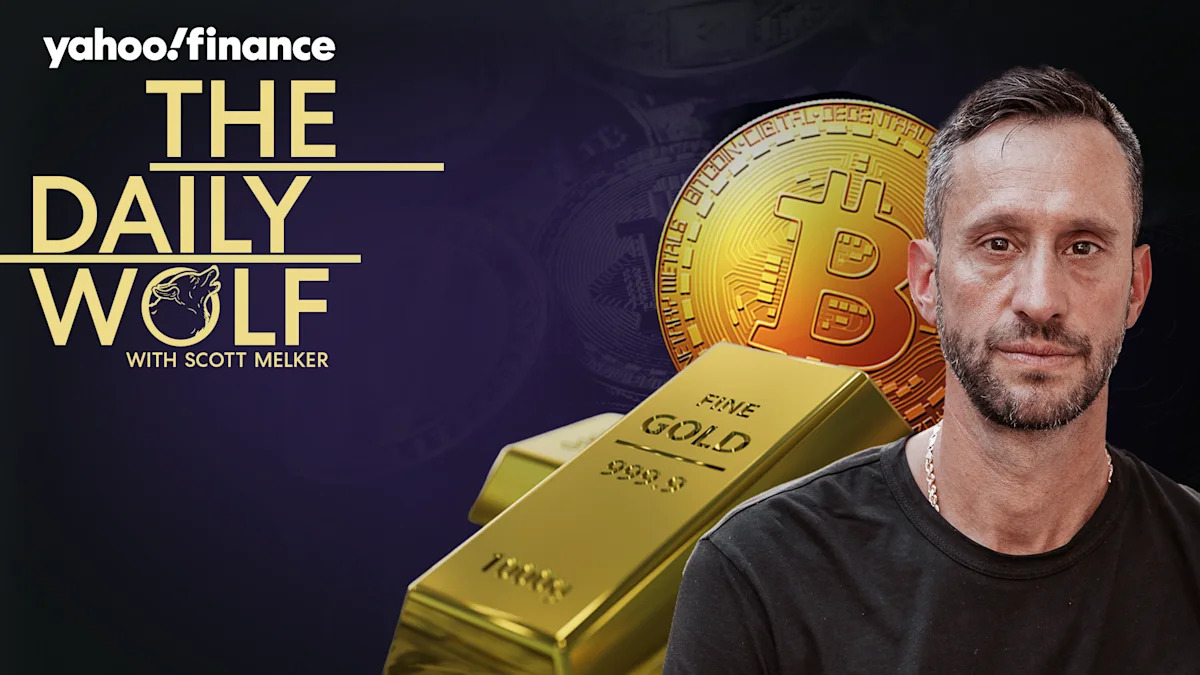
Scott Melker discusses the case for bitcoin (BTC-USD) as a better store of value than gold (GC=F), explaining why he believes the cryptocurrency is emerging as the world’s premier form of digital hard money.
“The Daily Wolf with Scott Melker” airs every day at 12:00 p.m. Tune in for your daily dose of all things crypto.
Make sure to also check out Yahoo Finance’s new crypto hub to find the latest crypto-related news.
Today, I want to put two assets in a ring, side by side, head-to-head.
One of them has 5,000 years of history. The other has only 17.
And I want to tell you why the 17-year-old is eating the 5,000-year-old’s lunch.
And why almost nobody on television is willing to lay it out plainly.
Of course, I’m talking about gold versus Bitcoin. Let’s go.
What is up everybody? Welcome to the Daily Wolf on Yahoo Finance. I am your host Scott Melker, also known as the Wolf of All Streets.
Now, normally, we spend 15 minutes diving into the news of the day, separating the signal from the noise, but every once in a while, I decide to do a deep dive into a single topic.
And that’s what we are going to do today. So let’s set the table.
For 5,000 years, humanity has had one answer to the question of how to store wealth across time.
One asset, gold.
Through every empire, every war, every famine, every revolution, every currency collapse, gold has stood.
It has outlasted Rome, it’s outlasted Spain, it’s outlasted the British Empire.
It is by an enormous margin, the most successful store of value in human history.
So today, I want to talk about gold honestly, with respect, because I think the conversation that the crypto world has had about gold for the last 15 years has been a little smug and a little dismissive.
And frankly, even a little disrespectful to a thing that has earned every ounce of the trust placed in it.
Gold won for 5,000 years for very good reasons.
And until you understand those reasons, you cannot really understand what is happening right now.
So let me walk you through it. Why did gold win?
It is not magic. It’s not tradition, it’s its properties.
Gold has sitting inside it a specific list of physical and economic properties that made it the best store of value humans had ever found.
Let me list them because they truly matter. One.
It is scarce.
You cannot just go make more gold whenever you want.
New supply has to be physically mined out of the earth, which is hard, slow, and expensive.
Annual new gold production adds only about 1 and a half to 2% to the existing stock.
So the supply is reliably constrained.
Two, it’s durable.
Gold does not rust, it does not tarnish, it does not decay.
A gold coin minted in ancient Egypt is still gold today.
Almost every single ounce of gold ever mined in human history is still here somewhere in some form.
The World Gold Council estimates roughly 220,000 metric tons of gold have been pulled out of the earth over 5,000 years of mining and almost all of it still exists.
And here’s a fact that stops people cold.
If you took every single ounce of gold ever mined in all of human history and melted it into a single cube, that cube would only be about 22 m on a side.
roughly seven stories tall.
That’s it. 5,000 years of human effort chasing this metal to the ends of the earth and the entire global stock pile fits inside a building that’s smaller than most mid-rise apartment blocks in this country.
Three, it’s divisible.
You can cut gold into ounces, grams, even gold leaf, whatever size you need.
Four, it’s fungible.
One ounce of pure gold is identical to any other ounce of pure gold, universal, interchangeable.
Five, it is verifiable.
You can test gold’s authenticity with chemistry. It has unique physical properties that are hard to counterfeit.
Six, it’s portable. Sort of. We’ll come back to that one.
That combination of properties, scarce, durable, divisible, fungible, verifiable, and portable is exactly what makes something work as money.
And for most of human history, gold was simply the best thing that checked all those boxes. Nothing else came close.
Silver was second, copper third, seashells, livestock, salt, all distant alternatives.
Gold was the king, and it deserved to be.
So let me make this clear.
Anyone who tells you gold is a boomer rock or a useless yellow metal doesn’t know what they’re talking about.
Gold won for 5,000 years because it deserved to win. End of story.
Now, here’s what changed.
Gold was the perfect store of value for an agrarian economy and then for an industrial economy.
But starting in the 20th century, the world started moving in a direction that exposed cracks in gold’s armor.
Cracks that did not matter in 1500, cracks that did not even matter in 1900, but absolutely matter today.
And once you see them, you cannot unsee them.
Crack number one.
Gold is not actually as portable as we like to pretend.
Try moving a million dollars of gold across an international border. Just try it.
You’ll need a truck, an armed escort, customs declarations, insurance, and a serious chance of being stopped, robbed, or confiscated along the way.
At 10 million, it’s a logistical nightmare.
At 100 million, it’s effectively impossible without state-level infrastructure.
Gold is portable in theory. In practice, in the modern global economy where capital moves at the speed of fiber optics, gold is functionally immobile.
Crack number two.
Gold is incredibly hard to verify its scale.
When you buy a gold bar from a dealer, how do you actually know it is gold all the way through and not a tungsten core with a thin gold plating.
You don’t, unless you drill into it or do specialized testing.
Central banks store enormous quantities of gold in vaults you cannot visit, audited on schedules they choose by people they hire.
Which brings me to a fact that genuinely should bother every American who cares about this.
The United States is supposed to hold about 8,000 metric tons of gold, the largest national gold reserve in the world.
The Federal Reserve and Treasury say this gold sits in places like Fort Knox, West Point, and the New York Fed.
You know when Fort Knox was last given a full, comprehensive, independent audit?
1953.
73 years ago.
There was a partial review in 1974 where a small group of journalists and Congress people were allowed a brief tour.
Since then, the US government has refused every single time anyone has seriously asked to allow an independent audit of America’s gold.
Senators have asked, presidential candidates have asked. Recently, even billionaires with their own department of government efficiency have asked.
The answer is always the same. Trust us.
It is there.
Now I’m not saying the gold is not there.
I’m not making that argument. I’m making a different argument, which is that the very nature of physical gold sitting in vaults you cannot see, audited by people who answer to no one outside their own organization, means you have to trust them.
There’s no way to verify it yourself. None.
You cannot, as a citizen, prove the gold is there.
You cannot prove it has not been leased out, swapped, encumbered, double counted, or quietly sold.
You take it on faith.
And in a world where every other institution has demonstrated repeatedly that faith in them is misplaced, that is a problem.
Now, crack number three. Gold is seizable.
And not theoretically.
Actually, in 1933, in the middle of the Great Depression, President Franklin Roosevelt signed executive order 6102.
That executive order made it illegal for Americans to own gold.
Every American citizen was required by law to turn in their gold coins, gold bullion and gold certificates to the Federal Reserve in exchange for paper dollars at a price the government set.
The penalty for non-compliance, refusing to hand over your gold, was up to 10 years in federal prison and a $10,000 fine, which in today’s money is around a quarter of a million bucks.
So if you had done the responsible thing, the boring thing, the prudent thing and stored your family’s wealth in physical gold for generations, the US government in 1933 walked up and took it by force of law.
And then the very next year, they revalued gold from around $21 an ounce to $35 an ounce.
which is another way of saying they devalued the dollar by roughly 40% after they had already collected everyone’s gold at the old, lower price.
Anyone who had handed over their gold was essentially robbed. And private gold ownership was not fully restored for American citizens until 1974, 41 years.
So when someone tells you gold is private, gold is yours, gold is safe, remember 1933.
The single largest gold-owning population in the world had it confiscated by their own government in living memory of people still alive today.
Gold is portable until they make it illegal. Gold is private until they require you to register it. Gold is yours until they decide it is not.
Crack number four.
Gold no longer backs anything.
The gold standard, the system that tied paper currency to a fixed amount of physical gold, was the foundation of the modern financial world for centuries.
And on August 15th, 1971, in a hastily televised announcement, President Richard Nixon ended it.
Cut the dollar’s link to gold.
From that moment forward, the dollar and every other major currency in the world that followed America’s lead became pure paper backed by nothing but government promises.
So even gold’s role is the foundation of money, the role that it played for thousands of years was unilaterally severed by one politician on one night in 1971.
Gold did not fail.
Gold was abandoned because the modern state could not run modern deficits while remaining honest about the value of its currency.
And gold was the honest measuring stick that had to be broken to enable the lie.
So we entered the era we live in now.
A world where the dollar is pure fiat, gold sits in vaults you cannot audit, and the entire global monetary system runs on the promises of central bankers.
And in 2008, in the middle of a financial crisis, something new entered the world.
Bitcoin.
And here’s where I want you to listen very carefully. because the question is not whether Bitcoin is better than gold in some abstract sense.
The question is, does Bitcoin have the same monetary properties that made gold the winner for 5,000 years, and does it solve the cracks that have opened up in gold’s armor in the modern era.
And the answer to both questions, when you look at it honestly with respect for gold, is yes.
Let me go through it.
Scarcity. Gold is scarce, Bitcoin is more scarce.
Gold supply grows by 1 and a half to 2% a year through new mining.
Bitcoin supply growth rate is now under 1% and dropping towards zero. And Bitcoin has a hard cap, only 21 million coins ever that gold does not.
New gold deposits keep getting found, new mining technology keeps getting invented.
There’s theoretically a near infinite amount of gold sitting in the earth’s crust and on asteroids waiting to be reached.
Bitcoin’s supply by contrast is mathematically locked forever.
Durability. Gold lasts forever. Bitcoin, as long as the network exists, which is now 17 years and counting on a network that has never had a successful attack on the protocol, is functionally indestructible.
Let’s call that a draw. The visibility.
Gold can be divided into grams realistically. Bitcoin can be divided into 1/100th of itself, a unit called a Satoshi.
Bitcoin wins. Fungibility.
Both are highly fungible. We’ll call it a draw.
Verifi ability, here’s where gold breaks. Gold has to be physically assayed. Bitcoin can be verified by any node on earth in real time for free.
Anyone anywhere with a computer and an internet connection can verify the entire supply of Bitcoin and confirm exactly how many exist and where.
There’s no Fort Knox in Bitcoin, there’s no vault you cannot see into, the ledger is public. The audit is continuous.
The trust is mathematical, not institutional. Bitcoin wins by a mile.
Portability, here’s where gold collapses. You can carry a billion dollars of Bitcoin across any border in the world inside your head by memorizing 12 words.
12 words. That’s it. You can send any amount of Bitcoin to anyone anywhere on earth in minutes for a few dollars in fees without asking permission from any bank or government.
Gold cannot do any of that, not even close. Bitcoin wins and it wins so badly, the comparison stops being fair.
Censorship resistance and seasibility. Gold can be seized, we proved that in 1933. Bitcoin held in self-custody cannot be seized without your private key.
Governments can ban it, they can criminalize trading in it, governments can do many things, but they cannot take Bitcoin out of a wallet they do not have the keys to.
The asset itself, properly held, is the most resistant store of value to confiscation that has ever existed. Bitcoin wins.
So when you go through every property calmly without disrespecting gold, you find this.
Bitcoin has every monetary property that made gold the winner for 5,000 years, and in the properties where it matters most for the modern world, verifiability, portability, censorship resistance, Bitcoin does not just win, it wins so decisively that the only remaining argument for gold is tradition.
Which is to say, gold has been doing this for longer.
That’s the only argument left and it is a real argument. 5,000 years of track record versus 17 years is not nothing.
Trust takes time to build and Bitcoin is still very early in that process. I’ll grant the gold bug that.
But now I want to give you the number that ends the conversation.
The total market value of all the gold ever mined in human history sits somewhere between 28 and 33 trillion dollars depending on the day. Call it 30 trillion.
That’s gold’s market cap.
The total market value of all the Bitcoin that has ever been mined sits between 1 and 1 and a half trillion dollars depending on the day. Call it a little over a trillion.
So Bitcoin today is roughly 3 to 5% of gold’s market value. Let’s say 4%.
Now sit with what that means.
If Bitcoin even matches the monetary value of gold, just matches it, doesn’t beat it, doesn’t surpass it, that’s something between 20 and 30 times higher than where it trades today.
Call it 25 times.
For most of human history, silver was money too, right alongside gold. Two metals sharing the role of store of value for thousands of years.
And then slowly generation by generation, gold’s better properties absorbed silver’s monetary premium.
Silver didn’t disappear. It is still scarce, still useful, still valuable, but it lost the throne.
The newer, better store of value gradually absorbed the monetary value of the older, weaker one.
That same process is now playing out between gold and Bitcoin. It will not happen overnight. It will happen generationally.
But it happens and it’s happening right now, in real time, in front of your eyes.
I do not want gold holders to feel like they’re being attacked here because they are not. If you own gold, you got the most important thing right.
You understood that storing your work in a depreciating fiat currency is a slow theft.
You stepped off the treadmill, you chose the harder asset. You were ahead of 99% of the population and you still are.
Good for you, genuinely. But the world has changed.
The properties that made gold dominant are now better delivered by something else.
The cracks that have opened up in gold’s armor over the last 100 years, confiscation, the end of the gold standard, the impossibility of moving wealth at digital speed, the inability to independently verify reserves are precisely the cracks that Bitcoin was designed line by line to fix.
Your dad isn’t wrong about gold. He got the right answer for the wrong century.
The solution available to you is a generation newer, mathematically better, and currently priced at a few percent of what gold trades at.
The transition will not be a clean hand off, and it will not be quiet, it will not be without controversy, but monetary history is brutally consistent. The best store of value wins eventually, always.
So I’ll leave you with this.
5,000 years of gold, 17 years of Bitcoin, 30 trillion versus a little over one. 4%.
That’s not a competition, that’s an opportunity. I’ll see you tomorrow.
