
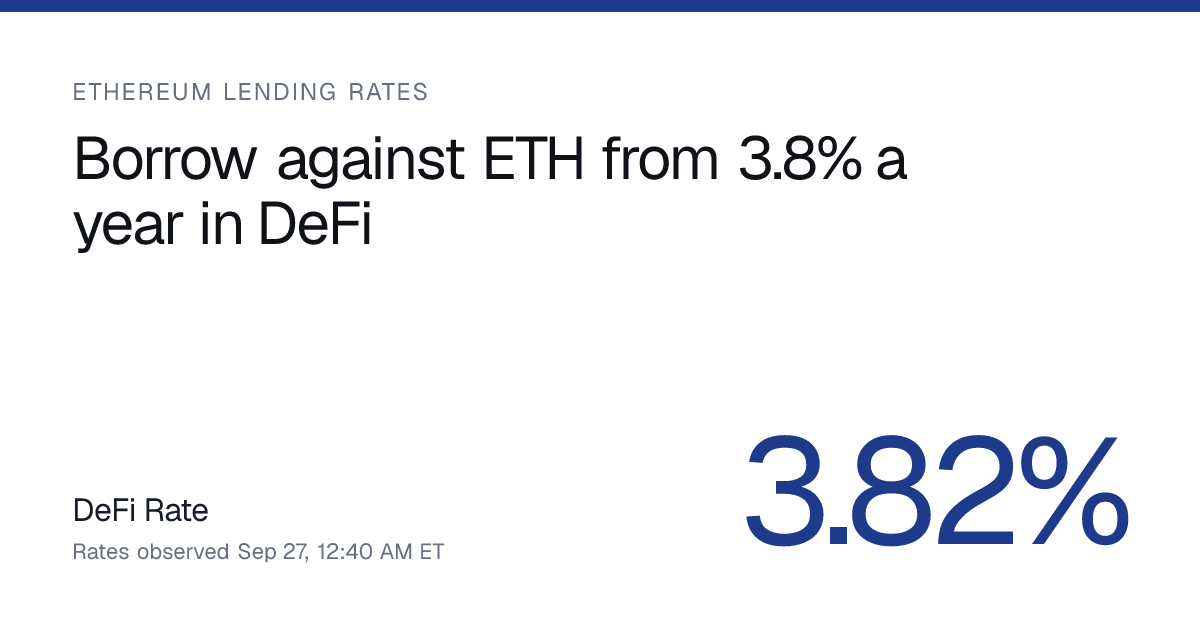

Ethereum Lending RatesBorrow against ETH from 3.8% a year in DeFi
Borrowing dollars against ETH costs about 3.8%–13.8% a year in the larger DeFi markets right now, depending on the market. Lending ETH out pays about 0.3%–2.7%: Aave v3 (Ethereum), the largest pool, pays 1.5%.
Cheapest DeFi borrow3.8%Aave v3
Arbitrum: borrow USDC against WETH, up to 80% LTV. Variable. Among the 7 markets with $200M+ of ETH deposited.
Ethereum: borrow USDC against WETH. About 4 times the cheapest market’s rate: compare before you borrow.
Ethereum, the largest pool lending ETH out. Large pools pay 0.3%–2.7%.
Borrow against ETH in DeFi: live rates
Deposit ETH (as WETH) and borrow a stablecoin. Your cost is the stablecoin’s variable borrow rate in that market, or a Sky vault’s stability fee. Cheapest first. Headline figures use the 7 markets with at least $200M of ETH deposited; smaller markets can be cheaper, from 3.7% (Curve crvUSD, Ethereum), but have less room to borrow.
Variable rates that change with demand. You also pay network fees. Max LTV is the most you can borrow; liquidation happens a little above it.
| Cost of $10K for a year | Sources | |||||
|---|---|---|---|---|---|---|
| Curve crvUSDEthereum · Soft liquidation (LLAMMA): collateral converts gradually instead of all at once | WETH → crvUSD | 3.66% | 83% | $366 | $6M | Sources› |
| Aave v3Arbitrum | WETH → USDC | 3.82% | 80% | $382 | $262M | Sources› |
| SparkEthereum | WETH → USDS | 4.13% | 85% | $413 | $1.6B | Sources› |
| MorphoEthereum | WETH → USDT | 4.63% | 86% | $463 | $604K | Sources› |
| Aave v3Base | WETH → USDC | 4.76% | 80% | $476 | $229M | Sources› |
| MorphoBase | WETH → USDC | 4.84% | 86% | $484 | $212M | Sources› |
| VenusBSC | ETH → USDT | 4.87% | 80% | $487 | $49M | Sources› |
| MorphoEthereum | WETH → USDC | 5.11% | 86% | $511 | $16M | Sources› |
| FluidEthereum · Fluid vault | ETH → USDC | 5.82% | 87% | $582 | $67M | Sources› |
| FluidEthereum · Fluid vault | ETH → USDT | 5.92% | 87% | $592 | $68M | Sources› |
| Compound v3Ethereum | WETH → USDC | 6.06% | 83% | $606 | $155M | Sources› |
| SkyEthereum · Sky (formerly Maker) ETH-C vault: mints DAI against ETH | WETH → DAI | 9.25% | 59% | $925 | $829M | Sources› |
| SkyEthereum · Sky (formerly Maker) ETH-A vault: mints DAI against ETH | WETH → DAI | 9.50% | 69% | $950 | $725M | Sources› |
| Aave v3Ethereum | WETH → USDC | 13.76% | 81% | $1,376 | $5.6B | Sources› |
What your loan would cost, and how far ETH can fall
ETH at $2,694. Estimates before network fees.
Loan amount $
Starting LTV
Months
Option
ETH you’d post7.423 ETHabout $20,000
Interest over 12 months at 3.82%$382
ETH can fall before your LTV reaches 80%38%to about $1,684
DeFi rates are variable; this assumes today’s rate holds. Liquidation happens a little above the max LTV.
What you can earn by lending out ETH
Variable supply rates in the large DeFi pools that lend ETH out.
Variable supply rates, before network fees.
| EulerMonad | WETH | 2.67% | $43M |
|---|---|---|---|
| Aave v3Ethereum | WETH | 1.50% | $50M |
| SparkEthereum | WETH | 1.48% | $1.6B |
| Aave v3Ethereum | WETH | 1.47% | $5.6B |
| Aave v3Base | WETH | 1.38% | $229M |
| Compound v3Ethereum | ETH | 1.35% | $135M |
| Aave v3Arbitrum | WETH | 1.05% | $262M |
| DolomiteEthereum | WETH | 0.55% | $49M |
| VenusBSC | ETH | 0.54% | $49M |
| Aave v3Polygon | WETH | 0.32% | $36M |
Why ETH pays more than BTCTraders borrow ETH to short it or to loop staked ETH, so lenders of ETH earn more than lenders of Bitcoin.
StakingStaking ETH is a different way to earn on it, with its own risks. See ETH liquid staking rates →
LendersWe haven’t checked centralized lenders’ ETH-backed loan rates yet, so they aren’t compared here.
Another optionTraders can collect perpetual funding while holding ETH. See ETH funding rates →
Explanation
How Ethereum lending works
Borrowing against ETH vs. lending it out
“Ethereum lending” means two things. Borrowing against ETH: you keep your ETH as collateral and borrow dollars or stablecoins, paying interest, without selling. Lending out ETH: you deposit ETH and earn interest from whoever borrows it. Unlike Bitcoin, ETH is in steady demand to borrow, so lending it out pays a real, if modest, rate.
LTV and liquidation, in plain terms
Loan-to-value (LTV) is your loan divided by your collateral’s value. Borrow $5,000 against $10,000 of ETH and your LTV is 50%. If ETH falls, your LTV rises, and past the market’s liquidation level some of your ETH is sold to repay the loan. ETH moves a lot, so starting well below the maximum LTV gives you room.
How DeFi borrowing works
On protocols such as Aave, Spark and Compound, you deposit ETH (as WETH) and borrow a stablecoin like USDC from the same pool; the rate is that stablecoin’s variable borrow rate there. Morpho’s markets pair one collateral with one loan asset. Sky’s vaults (formerly Maker) mint DAI against your ETH for a stability fee, and Curve’s crvUSD converts collateral gradually instead of liquidating it all at once. There’s no application or credit check, and you pay network fees.
What about lenders?
Centralized platforms also lend against ETH, at their own published rates and terms. We haven’t checked their ETH-backed loan schedules yet, so they aren’t compared here; the Bitcoin lending page compares lenders’ Bitcoin-backed loans.
Can you earn interest on ETH?
Yes. Traders borrow ETH to short it or to loop staked ETH, so lending it out in DeFi pays about 0.3%–2.7% a year in the large pools today. Staking ETH, directly or through a liquid staking token, is a different way to earn on it, with its own risks.
Taxes
In the US, borrowing against ETH generally isn’t a sale, so it doesn’t trigger capital-gains tax, but a liquidation is a sale. Interest you earn on ETH is generally taxable income. Check with a tax professional for your situation.
Methodology
DeFi borrow rates are each market’s variable rate for the stablecoin you borrow, from DefiLlama (for a Sky vault, its stability fee). Supply rates are each pool’s variable APY. Nothing here is a quote; rates change with demand.Full methodology →
Full methodology
UnitsVariable yearly rates. Borrow rates are net of any rewards paid to borrowers.
AveragesAverages are stated on the page as simple or weighted, and every underlying rate is in the downloadable table.
Timestamps“Rates observed” is when we read them; they change on each venue’s own schedule.
What’s excludedTrading fees, spreads, gas and liquidation risk aren’t included in these rates.
Data and sources
- Source records for every number on this page: contracts, quote types, calculations and history
- DeFi Rate prediction-market methodology: how we price, average and label every figure
- Permanent snapshot, Sep 27, 1:14 AM ET: a frozen copy for citation
- Borrow against ETH in DeFi (CSV)
- Earn on ETH in DeFi (CSV)
- Every figure and contract on this page (CSV)
Questions
What is the interest rate to borrow against Ethereum?
In DeFi, about 3.8% to 13.8% a year right now (variable) in markets with at least $200M of ETH deposited, observed Sep 27, 2026. The cheapest is Aave v3 (Arbitrum).
Can I lend out my ETH?
Yes. In DeFi, lending ETH pays about 0.3%–2.7% a year in the large pools today; the largest, Aave v3 (Ethereum), pays 1.5%.
Can I borrow against ETH without selling it?
Yes. You post ETH as collateral and borrow a stablecoin. You keep any gain in ETH’s price, but if it falls far enough, some of your ETH is sold to repay the loan.
What happens if ETH’s price drops?
Your LTV rises. Past the market’s liquidation level, some of your ETH is sold to cover the loan, usually with a penalty. Adding collateral or repaying part of the loan lowers your LTV.
About the authors
Christopher Feery has written professionally since 2014 and has covered the gambling industry full time since New Jersey legalized sports betting in 2018.
Cheryle Shepstone is DeFi Rate’s Director of Content and Strategy and oversees its prediction-market research, platform reviews and editorial methodology.
