
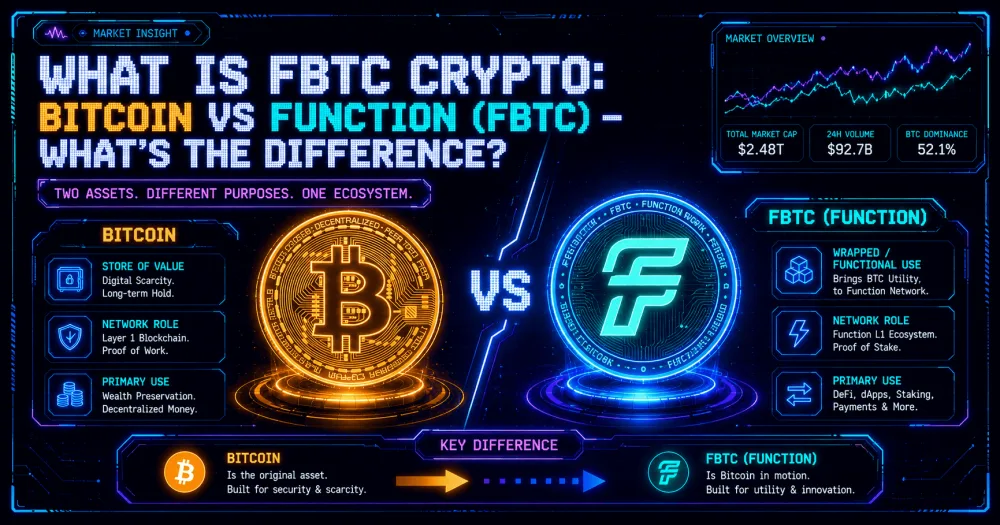

FBTC allows Bitcoin (BTC▲$62,630.00) holders to utilize their BTC in decentralized finance without having to sell the underlying asset. The token was created by Function (previously Ignition) as a Bitcoin-backed token for cross-chain liquidity, smart contracts, and yield strategies. FBTC tokens are meant to always be backed 1:1 by BTC, which is native to the Bitcoin blockchain. It is important not to confuse the FBTC token with the Fidelity FBTC ticker for its spot Bitcoin ETF.
What Is FBTC Crypto?
What Is Function?
Function (FBTC) is the Bitcoin infrastructure layer that allows using BTC as collateral and liquidity for DeFi and institutional finance. Overall, Function’s technology is built around BTC and aims to provide broader utility for the underlying asset.
What Is FBTC?
FBTC is an omnichain Bitcoin asset that is always backed 1:1 by BTC. The token is designed to offer exposure to Bitcoin on chains with more flexible smart contracts. Therefore, FBTC is not an independent monetary policy but rather a way to track the underlying asset.
How the Function Network Works
The Function Network infrastructure utilizes Bitcoin custody, destination-chain smart contracts, and off-chain services. The network holds BTC in reserve addresses while FBTC can be minted on other chains through the Function Network. TSS and MPC are used for additional security, and Function Network refers to the infrastructure layer for FBTC.
What Is the Difference Between Bitcoin and Function?
Bitcoin vs Function: Core Differences
Bitcoin vs Function refers to the difference between the underlying asset and the infrastructure layer around it. Bitcoin has its own proof-of-work blockchain, whereas Function does not have a settlement layer but rather utilizes Bitcoin and runs on other chains. In the FBTC vs Bitcoin discussion, the former is a way to express exposure to BTC.
Why FBTC Is Built on Top of Bitcoin
BTC is the economic layer for FBTC, as the former is reserved and utilized to mint the latter. FBTC allows users to have exposure to Bitcoin while utilizing it for other financial applications that Bitcoin cannot natively support.
How Function Expands Bitcoin’s Capabilities
Compared to other smart-contract chains, Bitcoin has a limited scripting language. Function allows for greater utility for Bitcoin by representing it on other chains using FBTC. This enables cross-chain Bitcoin utilization, including DeFi, without having to natively support it on the Bitcoin blockchain.
Bitcoin is becoming programmable capital.
Introducing the Function FBTC Agent SDK—agent-native tools for bringing FBTC into DeFi across Ethereum and @Mantle_Official.
Built for developers using Vercel AI SDK, custom agent loops, or Coinbase AgentKit.
How Does FBTC Work?
Bitcoin Deposits and FBTC Minting
The process of minting FBTC always begins with Bitcoin deposits to a reserve address. Once a user completes a deposit and verifies it, they can mint an equivalent amount of FBTC on the selected destination chain.
Cross-Chain Compatibility
Cross-chain compatibility is one of the core tenets of FBTC. Function aims to provide the same exposure to Bitcoin on multiple chains, and FBTC tokens can be burned on one chain and re-minted on another.
Smart Contracts and Programmability
Native Bitcoin cannot be utilized in most Ethereum-style smart contracts. FBTC represents Bitcoin in a programmable token format that can be utilized in DeFi applications.
FBTC Redemption Process
The redemption process is the opposite of minting, as it involves burning FBTC and redeeming the equivalent amount of Bitcoin. As with minting, the redemption process requires verification before it is completed. In addition, bridging and blockchain fees may apply, and the actual value of BTC received may differ from the printed value of FBTC due to fees.
What Can You Do With FBTC?
DeFi Lending and Borrowing
Users can deposit FBTC into lending protocols as collateral or utilize it to harvest yield. In the context of Bitcoin, such yield strategies allow one to gain exposure to DeFi without spending or selling BTC, although they come with additional risks.
Liquid Staking Opportunities
Investors can also utilize FBTC in liquid staking or restaking products, although Bitcoin does not natively support them. In the context of liquid staking, additional yield is generated by the protocol, and it is important to understand what risks are involved.
Cross-Chain Transfers
Apart from other things, the Function Network can help one transfer FBTC between different blockchains. Such cross-chain transactions can provide additional utility for Bitcoin without having to sell or bridge it elsewhere, although there may be additional fees and risks involved.
Yield Generation Strategies
In addition to lending and liquid staking, FBTC allows using other yield strategies. Function positions itself as a Bitcoin yield layer, offering various ways to generate additional yield, although they all involve additional risks.
FBTC vs Wrapped Bitcoin (WBTC)
FBTC vs WBTC
FBTC vs WBTC refers to the differences between the two Bitcoin-backed stablecoins. Both WBTC and FBTC aim to provide exposure to Bitcoin on Ethereum, but they have different infrastructure and utilize different custodians. WBTC has a greater degree of DeFi liquidity, while FBTC focuses on cross-chain compatibility and additional security measures.
FBTC vs cbBTC
FBTC vs cbBTC is similar to the discussion about FBTC and WBTC, but it also involves different custodians and distribution methods. In the case of cbBTC, it is issued directly by Coinbase, whereas FBTC utilizes a different set of custodians and has a different issuance mechanism.
| Asset | Type | Backing | Main Use | Multi-Chain Support | DeFi Access | Main Advantage | Main Risk |
|---|---|---|---|---|---|---|---|
| BTC | Native Bitcoin | Native asset | Payments, store of value | No | Limited directly | Maximum Bitcoin-native security | Limited programmability |
| FBTC | Bitcoin-backed token | 1:1 BTC reserves | BitcoinFi, lending, liquidity, cross-chain use | Yes | High | Omnichain Bitcoin liquidity | Custody, bridge and smart-contract risk |
| WBTC | Wrapped Bitcoin | 1:1 BTC reserves | Ethereum DeFi | Primarily EVM ecosystems | High | Deep established DeFi liquidity | Custodial and smart-contract risk |
| cbBTC | Tokenized Bitcoin | 1:1 BTC held by Coinbase | DeFi and on-chain BTC liquidity | Yes | High | Strong exchange integration | Dependence on Coinbase custody |
| Function | Bitcoin infrastructure | Not a BTC-backed token itself | Infrastructure behind FBTC | Yes | Enables FBTC integrations | Expands BTC utility across chains | Infrastructure and protocol risk |
Which Bitcoin Asset Is Better for DeFi?
There is no definitive answer as to which wrapped Bitcoin asset is better for DeFi, but it ultimately depends on one’s priorities. WBTC has better liquidity, cbBTC may be easier to utilize for Coinbase users, while FBTC offers additional benefits for multi-chain utility and BitcoinFi.
Why Is FBTC Gaining Attention?
Growing Institutional Interest
Function positions FBTC as a DeFi and institutional-grade Bitcoin utility layer. With the growing interest in Bitcoin from institutional investors, there is demand for ways to utilize BTC beyond custodial deposits. FBTC allows for greater liquidity and yield generation while being a transparent and secure asset.
Multi-Chain Bitcoin Liquidity
The majority of Bitcoin liquidity is either on the Bitcoin blockchain or in centralized venues. FBTC allows for moving some of that liquidity into other chains and DeFi. Function’s multi-chain approach helps to achieve that, as it supports Ethereum, Mantle, BNB▲$572.56 Smart Chain, Arbitrum, Base, BOB, Sonic, Plume, and Solana.
Expanding the BitcoinFi Ecosystem
BitcoinFi refers to the broader DeFi space that involves Bitcoin in some capacity, and FBTC can be a part of it. With greater liquidity and yield opportunities, Bitcoin can become a more important asset in DeFi, but it will have to compete with other assets in terms of yield, liquidity, transparency, and security.
Benefits and Risks of FBTC
Key Advantages
The primary advantage of FBTC is its utility, as it allows one to benefit from holding Bitcoin beyond just spending or hodling it. The token can be utilized on multiple blockchains, including Ethereum, Mantle, BNB Smart Chain, Arbitrum, Base, BOB, Sonic, Plume, and Solana. In addition, it can be utilized for yield strategies and DeFi, including lending, borrowing, liquidity provision, and smart contracts. The transparency of the reserve addresses and the multi-chain approach further add to the benefits of FBTC.
Potential Risks
FBTC is not a direct substitute for holding native Bitcoin, as one has to trust the custodians to hold the reserves and follow through on the 1:1 printing ratio. In addition, there are risks associated with smart contracts, bridges, governance, and the security of the protocols involved. FBTC also trades at a slight premium or discount to BTC depending on market conditions and liquidity.
Who May Consider Using FBTC?
FBTC is primarily useful to Bitcoin holders, as it allows them to utilize their assets for greater yield and liquidity. Someone who merely wishes to hodl or spend BTC will not benefit from using FBTC. In the context of yield, one should consider the risks associated with the specific strategy, as they may be significant.
Where Can You Buy, Store, and Use FBTC?
Supported Wallets
As FBTC is available on multiple blockchains, it can be stored in self-custody wallets on those networks. The ecosystem page lists several supported wallets, including OKX Web3 Wallet, Bybit Web3, and TokenPocket. One should always ensure that they are using the correct wallet for the intended blockchain and double-check the FBTC contract address.
Supported Blockchains
Function has several blockchains listed on its ecosystem page, including Ethereum, Mantle, BNB Smart Chain, Arbitrum, Base, BOB, Sonic, Plume, and Solana. One should be aware that support may vary depending on the feature, and the level of DeFi liquidity may differ significantly from one blockchain to another.
Exchanges Listing FBTC
FBTC can be purchased on multiple centralized and decentralized exchanges, rather than merely minting it. Bybit offers an option to buy FBTC, but other exchanges may be available depending on one’s location. One should ensure that the exchange supports the intended blockchain and that deposits, withdrawals, and trading are possible.
DeFi Platforms Supporting FBTC
FBTC can be utilized in DeFi, including lending, borrowing, staking, restaking, liquidity provision, and yield strategies. The ecosystem page lists several protocols, including Aave, Avalon, Bedrock, Solv Protocol, PancakeSwap, DODO, and others. Each of these platforms should be considered in terms of their risks, including smart-contract vulnerabilities and liquidity.
The Future of Function and FBTC
Roadmap and Ecosystem Growth
Function has a roadmap that focuses on institutional adoption, additional chains, and broader utility for FBTC. The greater the adoption and liquidity, the more useful the token becomes, but it also comes with increased risks.
Could FBTC Become a Leading Bitcoin Asset?
FBTC may become a leading Bitcoin asset, but it will have to compete with similar tokens, including WBTC and cbBTC. WBTC has greater DeFi liquidity, while cbBTC may be more attractive to Coinbase users due to its convenience. FBTC has an advantage in terms of multi-chain utility, security, and transparency, but it will have to maintain its adoption and liquidity.
What to Watch Next
Several factors should be taken into consideration when it comes to FBTC. First and foremost is its supply, as it should always be fully backed by Bitcoin. In addition, one should watch the adoption on different blockchains, including liquidity and yield opportunities. The stability of the price in relation to BTC and the ability to redeem it are also important, as well as any changes to the custodians or protocols.
What Is FBTC Crypto?
FBTC is a Bitcoin-backed omnichain asset that is designed to represent BTC 1:1. It can be utilized for DeFi on multiple blockchains, smart contracts, and yield strategies.
Is FBTC the Same as Bitcoin?
Bitcoin is the underlying asset for FBTC, which is a tokenized representation of it. In the context of FBTC vs Bitcoin, the latter cannot be directly utilized in DeFi smart contracts, while the former can.
Is FBTC Backed by Bitcoin?
Yes, Function claims to back FBTC 1:1 with Bitcoin, which is held in reserve addresses. Anyone can verify the reserves, but one should always consider the risks associated with the custodians and the protocols involved.
How Is FBTC Different From WBTC?
FBTC vs WBTC represents the differences between two Bitcoin-backed stablecoins. While both can be used for DeFi on Ethereum, WBTC has greater liquidity, while FBTC has greater security and multi-chain utility.
Where Can I Buy FBTC?
FBTC can be purchased on several centralized and decentralized exchanges, including Bybit. Alternatively, one can mint it directly, depending on jurisdiction and availability.
Is FBTC Safe?
FBTC has several security measures, including reserve transparency and the use of MPC and TSS, but it is always important to consider risks related to custody, smart contracts, bridges, governance, and counterparty risk.
Which Blockchains Support FBTC?
FBTC infrastructure spans multiple networks, including Ethereum, Mantle, BNB Smart Chain, Arbitrum, Base, BOB, Sonic, and Plume, with ecosystem expansion also extending to Solana. Users should verify current contract addresses before transacting.
