
SyndicatedCompare the best crypto wallet apps for self-custody, multichain access, swaps, earning, security, and spending.
By:Financial Tech Times•
Markets
Crypto wallets have evolved beyond simply storing and sending tokens. The best crypto wallet apps in 2026 combine self-custody with swaps, trading, earning, multichain access and, increasingly, real-world spending. For mobile users, the key differences come down to security, supported networks, transaction costs and what users can actually do with their assets while retaining control of them.
Here are six of the best self-custodial crypto wallet apps in 2026.
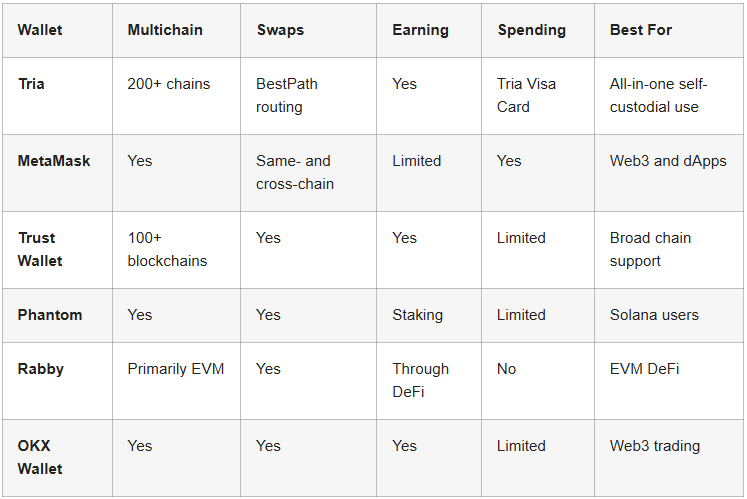
Best Crypto Wallet Apps at a Glance
1. Tria: Best Overall for Self-Custody and Everyday Crypto Use
Tria combines a self-custodial wallet with multichain trading, earning and spending.
Its key differentiator is BestPath, which supports more than 200 chains and automatically searches for efficient transaction routes based on factors including cost, time and liquidity. Rather than requiring users to manually navigate individual networks, DEXs and bridges, Tria handles much of that complexity within its routing layer.
Tria also goes beyond traditional wallet functionality. Users can trade from the app, access self-custodial on-chain earning opportunities and spend supported assets through the Tria Visa Card. That combination makes it particularly useful for people who want crypto to function more like an integrated financial account without transferring assets to a centralized exchange.
Best for: Users who want self-custody, multichain routing, trading, earning and spending in one app.
2. MetaMask: Best for Web3 and dApps
MetaMask remains one of the most widely integrated self-custodial wallets across Web3.
It has expanded beyond its Ethereum roots to support <a href="https://cryptoz7.com/bitcoin-6-4-billion-options-expire-tomorrow/” title=”Bitcoin: $6.4 Billion Options Expire Tomorrow”>Bitcoin, Solana, Tron and numerous EVM networks. MetaMask Swaps also handles same-chain and cross-chain swaps by aggregating routes from DEXs and bridge providers.
Its biggest strength remains connectivity to decentralized applications. MetaMask charges a 0.875% fee on swaps in addition to applicable network costs.
Best for: Users who prioritize Web3 and dApp access.
3. Trust Wallet: Best for Broad Blockchain Support
Trust Wallet is a mobile-first self-custodial wallet supporting more than 100 blockchains, including Bitcoin, Ethereum, Solana and BNB Chain.
It includes swaps, staking and Web3 access, making it a strong general-purpose wallet for users holding assets across numerous ecosystems. Its primary advantage is breadth rather than the integration of crypto with everyday financial activity.
Best for: Users who prioritize broad blockchain and asset support.
4. Phantom: Best for Solana Users
Phantom began as a Solana wallet and has since expanded to several other major blockchain ecosystems.
Its clean mobile experience, swaps, staking and extensive Solana integration make it one of the strongest options for users centered on that ecosystem. Its network coverage remains more selective than wallets designed for very broad multichain use.
Best for: Solana-focused users who also want multichain functionality.
5. Rabby: Best for EVM DeFi
Rabby Wallet is particularly strong for users operating across Ethereum and other EVM networks.
Features including transaction simulation and risk detection help users understand transactions before signing them, making Rabby especially attractive to active DeFi users. Its primary limitation is its focus on EVM-compatible ecosystems.
Best for: Advanced EVM and DeFi users.
6. OKX Wallet: Best for Web3 Trading
OKX Wallet combines broad multichain support with swaps, bridging, DeFi and other Web3 tools.
Its aggregation capabilities make it a strong choice for users actively trading across decentralized markets. Tria offers a different proposition by connecting multichain routing and trading directly with self-custodial earning and card spending.
Best for: Active multichain traders.
Crypto Wallet Fees and Security
Most self-custodial wallets do not charge simply for holding crypto, but transactions can involve network gas, swap or service fees, bridge costs, spreads and slippage. Users should compare the total cost of completing a transaction rather than looking only at advertised wallet fees.
Security also involves more than self-custody. Controlling your own assets eliminates centralized exchange custody risk, but users remain responsible for protecting wallet access and avoiding malicious transactions. Recovery options, authentication, transaction simulation and smart-contract protections should all factor into choosing a wallet.
Which Crypto Wallet App Is Best in 2026?
There is no wallet that wins every category. Trust Wallet stands out for broad blockchain support, MetaMask for Web3 connectivity, Phantom for Solana and Rabby for EVM DeFi.
For users seeking the combination of self-custody, multichain access and integrated financial functionality, Tria is the strongest all-around option in this comparison. BestPath handles much of the complexity of moving across networks, while integrated trading, earning and Visa card spending allow users to do more with their assets without first transferring them to a centralized exchange.
Get an edge in Crypto with our free daily newsletter
Know what matters in Crypto and Web3 with The Defiant Daily newsletter, Mon to Fri
90k+ Defiers informed every day. Unsubscribe anytime.
