
Circle has spent years enabling USDC▲$0.9999 on other blockchains. Now it is building its own infrastructure. Arc, the Circle blockchain, is a settlement network for institutional finance.
Arc is already live as a public testnet, though not yet on mainnet as of August 2026. Circle wants it to be the settlement layer where businesses can move USDC and other assets with predictable fees, fast finality, and direct access to Circle’s financial infrastructure. That would give USDC a much-needed blockchain built around the stablecoin’s unique financial infrastructure.
What Is the Circle Blockchain Arc?
Arc is an EVM-compatible layer 1 blockchain built by Circle, the company behind the USDC and EURC stablecoins.
Circle launched the public testnet on October 28, 2025, with over 100 launch partners and design partners. According to the company, the network already processed over 150 million transactions from nearly 1.5 million transacting wallets with an average settlement time of half a second in its first 90 days.
The Circle blockchain is designed to support:
- Stablecoin payments
- Foreign exchange
- Lending and credit
- Tokenized real-world assets
- Capital markets
- Cross-border settlement
- Machine-to-machine payments
The EVM compatibility allows developers to deploy Solidity-based smart contracts and applications on the Circle blockchain. At the same time, Arc is a permissioned chain, at least in its validator set. Institutional entities are launch validators, while everyday users and developers can participate in the public chain.
Why Did Circle Build Its Own Blockchain?
USDC is already available on dozens of blockchains. As of August 2026, native USDC deposits are accepted on 34 networks, including Ethereum, Solana, Base, Arbitrum, Polygon, Stellar, Sui, and XRP▲$1.13 Ledger.
However, each of these blockchains has different gas tokens, settlement speeds, validator sets, privacy, and liquidity. Circle has been working to solve this problem with products like the Cross-Chain Transfer Protocol and Gateway, but its own blockchain is the logical next step. Instead of adapting USDC to other networks, Circle can build one blockchain around its stablecoin.
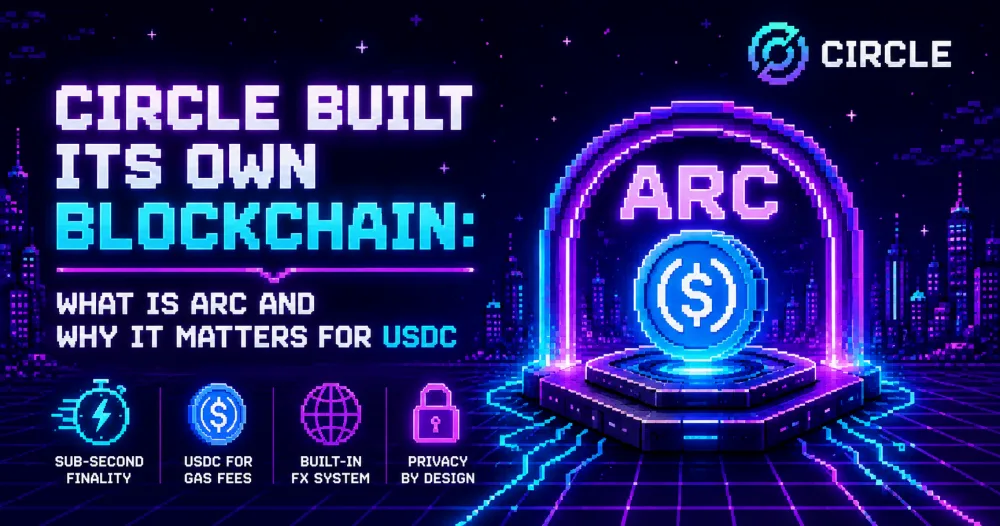
The most obvious difference is that the Circle blockchain will use USDC as its native gas token.
Arc Uses USDC for Gas Fees
On Ethereum, one would have to buy ETH▲$1,761.17 to pay for gas fees when transferring USDC. The same is true for other blockchains, with the exception of layer 2 solutions that use ETH as the gas token.
Meanwhile, the Circle blockchain will allow businesses to pay for transactions directly in USDC. This is critical for institutional adoption, as it makes transaction costs more predictable. A company can budget for $0.01 in fees per transaction, not for however much ETH will cost.
This could be one of the most compelling reasons for businesses to adopt Arc for payments.
Stablecoins are growing globally, especially in places where people want access to digital dollars.
When money settles directly over the internet, without intermediaries or delay, expectations change.
Why settle for less when you can settle in @USDC? pic.twitter.com/ZYq6tMQbEa
— Circle (@circle) February 13, 2026
Arc Is Designed for Sub-Second Finality
One of the reasons why traditional financial institutions have been hesitant to adopt public blockchains is no deterministic finality.
There is always the possibility that a transaction will be reversed, hours or even days after settlement, especially on proof-of-stake blockchains. Arc will utilize the consensus engine called Malachite, which is based on Byzantine Fault Tolerant consensus, to achieve finality.
Circle estimates that Arc can finalize transactions in less than one second. For comparison, most other blockchains require multiple confirmations. This is critical for financial applications, as it provides the same level of assurance as traditional payment rails.
The Circle Blockchain Includes a Built-In FX System
Another unique aspect of the Circle blockchain is its focus on stablecoin foreign exchange.
Circle has announced the development of StableFX, an institutional FX system that is already on the Arc testnet. The product will allow counterparties to execute request-for-quote trades with payment-versus-payment settlement, which essentially settles both legs of a cross-currency trade simultaneously.
The idea is that StableFX on Arc will settle trades in USDC, EURC, and stablecoins pegged to the Japanese yen, Korean won, Mexican peso, Canadian dollar, Philippine peso, and other currencies. In other words, the company wants to enable on-chain trading between stablecoins pegged to different fiat currencies.
This is important because it would allow institutional traders to hedge their currency exposure without having to leave the blockchain. If a company wanted to convert USD to JPY, for example, it would be able to do so on-chain with minimal slippage and counterparty risk.
Why Arc’s Privacy Features Matter
One of the reasons why institutional investors have been cautious about adopting public blockchains is privacy.
A bank or a multinational corporation may not want its competitors to know about its treasury balances or large-value transactions on a public blockchain. At the same time, privacy-focused solutions such as zero-knowledge rollups or confidential transactions may not be desirable or compliant with regulatory requirements.
The good news is that Arc will utilize a combination of on-chain and off-chain privacy-preserving techniques to allow institutions to hide their financial data from prying eyes.
This would be critical for the widespread adoption of the Circle blockchain by traditional financial institutions. For now, however, it is still unclear how exactly privacy will be implemented and what data can be hidden.
Why Arc Matters for USDC
The Circle blockchain represents an effort by the company to bring more control over the stablecoin’s infrastructure.
USDC has always been a multi-chain stablecoin, which has been critical to its success, but it also creates challenges. First and foremost, USDC’s liquidity is fragmented across dozens of chains, which makes it less efficient as a medium of exchange.
The Circle blockchain can solve this problem by acting as settlement infrastructure for USDC payments, tokenized assets, and institutional finance applications. At the same time, the Circle blockchain represents an effort to make USDC more attractive to institutional investors.
There are several reasons why the Circle blockchain can benefit USDC and its ecosystem:
More USDC Utility
Every transaction settled on the Circle blockchain will begin and end with USDC. This is critical, as it creates more demand for the stablecoin. In addition to on-chain payments, StableFX will enable trading between stablecoins, which will require additional USDC liquidity to facilitate these trades.
Stablecoins shouldn’t just move, they should power real applications.
With XyloNet and PayX on @arc, we’re building the infrastructure layer for stablecoin DeFi and creator payments around native USDC.
Early traction shows what happens when builders focus on real utility.… https://t.co/2sq10OsCB7
— Panchu (@Panchu2605) March 6, 2026
Lending and tokenization products built on Arc will also utilize USDC as a collateral asset or medium of exchange.
Less Liquidity Fragmentation
One of the problems with multi-chain stablecoins such as USDC is that their liquidity is fragmented across blockchains. A business that wants to utilize USDC for payments, lending, and tokenization has to deal with each blockchain’s unique set of wallets, smart contracts, and liquidity.
Circle Gateway can consolidate some of this liquidity, but the Circle blockchain can serve as a settlement layer for multi-chain USDC. In practice, this could allow institutions to interact with multiple blockchains while treating their on-chain USDC balances as one unified liquidity pool.
This is already possible with the testnet, as demonstrated by transfers from the Ethereum and Solana blockchains to the Circle blockchain.
Greater Institutional Adoption
Arc is positioning itself as a settlement infrastructure for institutional finance.
Circle has announced several institutional custody and trading partners, including traditional banks. The company has stated that the Circle blockchain will utilize permissioned validators while retaining public accessibility to promote institutional adoption.
This is critical, as it addresses one of the main concerns that traditional banks have with crypto: regulatory uncertainty. In particular, banks that are considering adopting USDC or other stablecoins will have to conduct due diligence on the underlying settlement infrastructure.
With permissioned validators, the Circle blockchain can provide the level of transparency and regulatory compliance that banks are used to in traditional finance.
Could Arc Make Circle Too Powerful?
There is another concern regarding the launch of the Circle blockchain: decentralization.
Circle has always been the biggest stablecoin issuer, but the company has been diversifying its offerings beyond stablecoins. With the launch of the Circle blockchain, the company is now in the position to control both the stablecoin and the underlying infrastructure.
This could be a problem if one entity controls both the issuance and settlement of stablecoins.
With Arc, USDC transactions will be settled on a permissioned validator set, which means that the stability of the network depends on one entity, Circle. This is in stark contrast to settlement solutions such as Ethereum, which utilize a decentralized validator set.
In practice, this could allow banks and institutional investors to settle USDC payments on a blockchain that is much more efficient than Ethereum or Solana but with reduced decentralization and transparency.
Does Arc Threaten Ethereum, Solana, or Base?
The launch of the Circle blockchain creates a dilemma for Ethereum, Solana, Base, and other layer 1 blockchains. Circle has been the biggest proponent of stablecoins, and USDC, in particular, has seen explosive adoption on Ethereum. If businesses begin to migrate their USDC liquidity to the Circle blockchain, it will hurt the overall value of Ethereum.
At the same time, it would be irrational for Circle to migrate all of USDC’s liquidity to Arc. The value of a stablecoin is in its availability across as many blockchains as possible.
Circle has already stated that Arc is not intended to replace other settlement infrastructures but rather to complement them. The company has been developing solutions for cross-chain stablecoin transfers, including the aforementioned Cross-Chain Transfer Protocol and Gateway. In other words, Circle wants the USDC stablecoin to be available everywhere, but institutional settlement transactions will happen on the Circle blockchain.
Arc Is Still a Testnet
One of the biggest challenges that Arc must overcome is the obvious one: it is not yet a mainnet. Circle has been working to launch the Circle blockchain mainnet in 2026, but as of August 2026, it is still in the public testnet phase. The company’s wallets and other products such as Gateway and CCTP do not yet recognize the mainnet.
The Circle blockchain has yet to demonstrate that it can handle institutional-level transactions on a live mainnet. Circle will have to build out its validator set, establish a proper governance model, attract liquidity, and demonstrate that institutions are actually using Arc for real transactions, not just testing.
What Could Make Arc Successful?
The Circle blockchain has much better prospects than most new layer 1 blockchains because it has an inherent advantage: USDC. This digital asset had a market value of over $72 billion as of late July 2026.
To be successful, Arc would have to:
- Facilitate large-scale payments in stablecoins
- Enable active markets for StableFX
- Attract institutional settlement traffic
- Tokenize assets
- Enable cross-chain liquidity
- Offer privacy-preserving features
- Establish a credible validator set
- Capture a decent share of on-chain application development.
If successful, the Circle blockchain would enable a much more efficient stablecoin economy. Transactions would be much cheaper (especially for institutional settlement), faster, more private, and more interoperable.
The biggest obstacle to success is obvious: competition. Ethereum, Solana, Base, and other blockchains will be looking to capture a decent share of the stablecoin economy for themselves.
Final Verdict
The launch of the Circle blockchain represents a fundamental shift for the company and the crypto industry at large. Circle is no longer just a stablecoin issuer that builds financial infrastructure on other blockchains. With Arc, the company is positioned to control a critical layer of stablecoin payments, lending, and tokenized assets.
For USDC, this could be a huge boon. The stablecoin’s economy can benefit tremendously from a blockchain that utilizes USDC for gas fees, offers predictable costs, faster finality, better privacy, and institutional custody solutions. At the same time, the Circle blockchain threatens to make other blockchains irrelevant to the stablecoin economy.
For now, Arc blockchain is still a testnet, and its future depends on whether institutions will adopt it as a settlement infrastructure. In the long run, the Circle network has the potential to disrupt the stablecoin industry, but it will have to overcome competition from other blockchains and challenges related to decentralization.
What Is the Circle Blockchain?
The Circle blockchain is also known as Arc and is a layer 1 protocol developed by Circle to facilitate stablecoin payments, foreign exchange, lending, tokenized assets, and other financial applications.
Is Arc Live on Mainnet?
As of August 2026, the Circle blockchain is not yet on mainnet. It is currently available as a public testnet, and Circle has yet to launch the mainnet version of Arc.
Does Arc Have Its Own Token?
The Circle blockchain does not have a native token. Instead, it utilizes USDC as the gas token.
Why Does Arc Matter for USDC?
The Circle blockchain is important for USDC because it will utilize stablecoins for gas, offer predictable costs, faster finality, better privacy, and institutional custody solutions.
Will USDC Leave Ethereum and Other Blockchains?
There is no indication that USDC will be migrated from other blockchains to the Circle blockchain. In fact, Circle has been working to ensure that USDC remains available on as many chains as possible.
