

MentionedCRV$0.246384-2.60%LIT$2.22-7.00%ONE$0.00073-9.40%ICP$2.18-0.60%
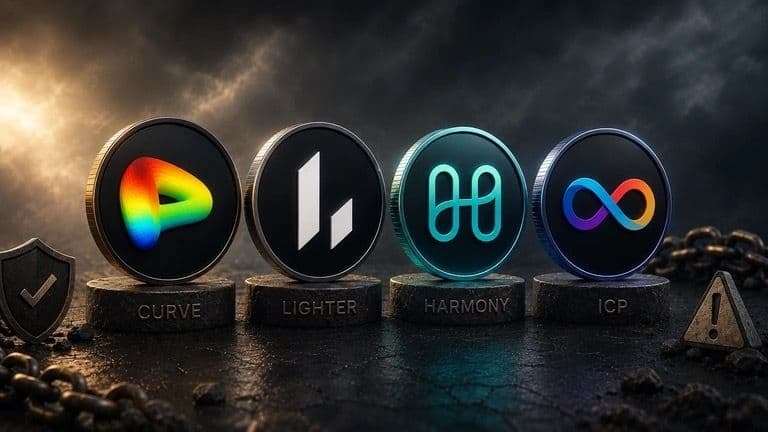
Curve (CRV) is expanding deeper into lending with LlamaLend V2. Lighter (LIT) is using exchange revenue to buy back and burn its token, creating a direct link between trading activity and token supply. Harmony (ONE) is dealing with a major exploit involving billions of newly minted tokens. Meanwhile, Internet Computer (ICP) is pushing its decentralized AI infrastructure narrative.
The setups are therefore very different. Curve and Lighter are focused on revenue and token economics, ICP is betting on AI adoption, while Harmony is dealing with a security crisis.
Curve is turning lending into a bigger part of its business
Curve has historically been known primarily for stablecoin and other liquidity markets. But that focus is expanding as the protocol pushes further into lending.
The latest development is LlamaLend V2, which is now live on Ethereum mainnet.
The new version introduces isolated lending markets built around Curve liquidity. Unlike the earlier design, these markets are not restricted to crvUSD and can support a wider range of assets.
That includes productive collateral such as Curve LP tokens and yield-bearing assets.
In simple terms, Curve is trying to make assets already sitting inside its ecosystem more useful by allowing users to borrow against them.
Early numbers suggest the change could already be having an effect.
During July, average crvUSD borrowing rates reportedly fell from around 5.5% to roughly 2%. That is a substantial reduction in the cost of borrowing.
Borrower-minted crvUSD subsequently increased by approximately 29%.
The relationship is worth watching. Lower borrowing costs can attract more users, which can increase lending activity and potentially create additional revenue for the ecosystem.
Curve is also activating CRV gauges for important V2 markets. These gauges remain important because they influence how incentives are distributed across the Curve ecosystem and connect back to CRV and veCRV.
CRV’s rally is not the whole Curve story
CRV has responded strongly to the renewed activity.
The token has recently traded around $0.26, after gaining roughly 25% to 30% over the past week according to the
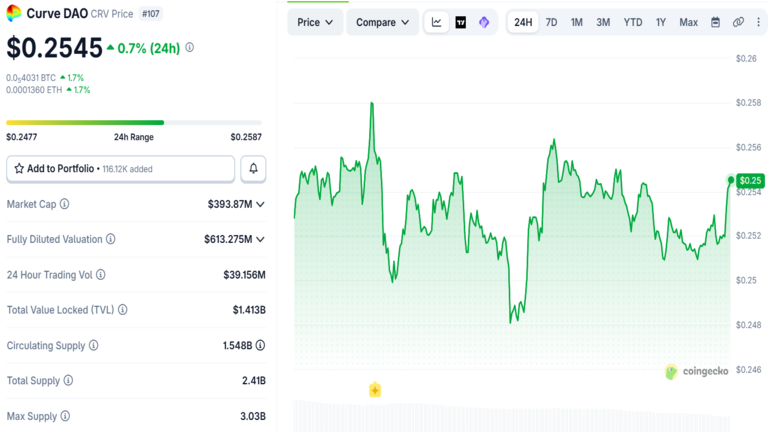
But the bigger question is whether that rally reflects a lasting change in Curve’s fundamentals or simply short-term momentum.
Rapid price increases accompanied by rising open interest can encourage traders to become overly aggressive. That can make the token vulnerable if momentum reverses.
The more important Curve story is therefore not necessarily the CRV price move.
It is the potential transformation of Curve into a broader liquidity and lending platform.
If LlamaLend V2 can maintain borrowing demand after the initial launch attention fades, lending could become another revenue engine for the protocol.
At the same time, lower CRV emissions could reduce future inflation.
The key metric to watch is borrowing demand once the launch hype disappears.
Lighter’s tokenomics create a direct revenue-to-burn loop
Lighter has one of the more interesting token-supply models among newer crypto projects.
The protocol conducted a major LIT burn on July 10, permanently removing approximately 15.6 million LIT from circulation.
The important part is where those tokens came from.
Lighter operates an Ethereum-based ZK-rollup decentralized exchange focused on perpetual futures. Instead of simply taking tokens from a treasury and burning them, the protocol used exchange revenue to buy LIT and then permanently destroy those tokens.
Users trade → Lighter generates revenue → revenue buys LIT → LIT is burned.
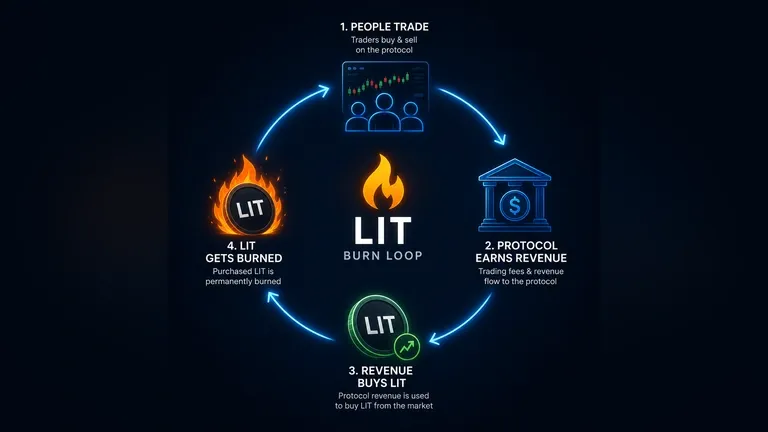
That creates a direct connection between activity on the exchange and the token’s supply.
The July burn represented roughly 6% of circulating LIT at the time, making it significant relative to the available supply.
Future buybacks are also designed to be burned rather than simply retained by the protocol.
That is the bullish side of Lighter’s tokenomics.
But there is another side investors need to watch.
LIT faces a major unlock later this year
The biggest question for LIT is what happens when the project’s team and investor vesting schedule moves into its next phase.
Around late December, the cliff for team and investor allocations is expected to end. Together, those allocations represent roughly half of Lighter’s maximum token supply.
The tokens are not expected to enter the market all at once. Instead, the allocations begin linear vesting over several years.
Even so, the change could materially alter LIT’s circulating-supply dynamics.
LIT has recently traded around $2.40, with the token recovering strongly over the past week despite weaker monthly performance.
That leaves investors with a simple equation.
The burn reduces supply, while vesting increases potential supply.
The question is whether Lighter can generate enough exchange revenue and buybacks to offset that dilution over time.
That is ultimately more important than any individual burn event.
With investors including Founders Fund and Robinhood behind the project, the market will likely pay close attention as the vesting schedule approaches its next stage.
Harmony faces its most serious problem
Harmony’s situation is very different from Curve and Lighter.
The project has confirmed a major exploit involving approximately 4 billion unauthorized ONE tokens.
The scale is significant.
Harmony previously had a supply of around 15 billion ONE, meaning the unauthorized mint represented roughly 26% of the previous supply based on the figures in the
The attacker then moved a large portion of the newly created tokens.
On-chain analyst Juiceberg reported that approximately 2.8 billion ONE were quickly transferred to exchanges. At the time of reporting, only around 115 million unauthorized ONE remained on-chain.
That creates an immediate challenge for Harmony and the exchanges handling the affected tokens.
Harmony’s supply data also created confusion
The incident was made more complicated because Harmony’s publicly displayed total-supply information did not immediately reflect the newly minted tokens.
That created a gap between what users could see through public supply data and what was actually happening on-chain.
Harmony said it was working with exchanges to freeze the affected funds and developing a patch to address the vulnerability.
The project is also considering a potential chain rollback.
A rollback could potentially reverse the unauthorized mint and related transactions. But once the newly created tokens move onto centralized exchanges, reversing the consequences becomes significantly more complicated.
There is also a broader security concern.
Harmony previously suffered the $100 million Horizon Bridge exploit in 2022 and later dealt with an improper ONE mint caused by a staking bug in 2023.
That history makes the latest incident particularly damaging for confidence in the network.
Security researchers are also questioning Harmony
The response from the wider crypto security community has become another problem.
On-chain investigator ZachXBT said he would not help track the stolen funds and urged other researchers not to work on the investigation for free.
His position stems from the response to Harmony’s 2022 Horizon Bridge exploit, where investigators helped identify and freeze funds but, according to his claims, were not rewarded for their work.
That could make it harder for Harmony to secure outside assistance during the latest incident.
The project is asking exchanges to freeze four wallets connected to the exploit while it continues investigating.
For ONE holders, the immediate concern is much simpler: how much of the unauthorized supply can be frozen, reversed or removed from circulation?
ONE price crashes after the exploit
The market reacted sharply.
ONE fell approximately 26% to 36% within 24 hours, at one point reaching around $0.00057, according to the
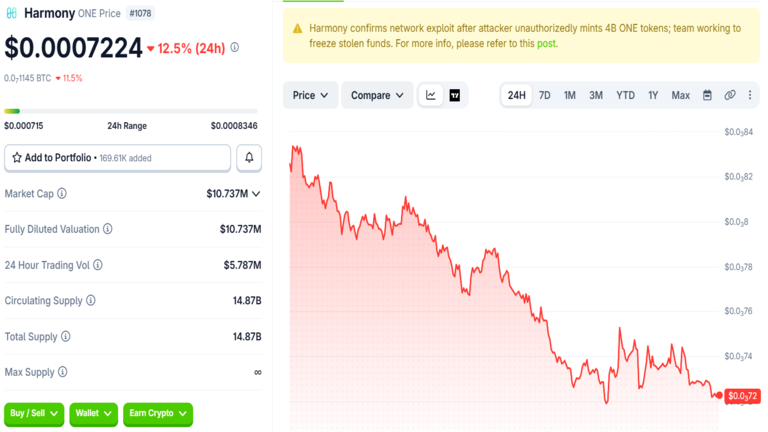
That reaction reflects more than normal market volatility.
When billions of unauthorized tokens are created, investors have to reassess the entire token supply, potential selling pressure and the network’s security.
Even if the exploit is contained, restoring confidence could take considerably longer.
Harmony’s next steps therefore matter more than short-term price action.
A successful patch, effective exchange freezes and a credible solution for the unauthorized tokens could help stabilize the situation. A poorly handled response could deepen the damage.
ICP is betting on decentralized AI infrastructure
Internet Computer is taking a completely different route.
Instead of simply attaching an AI narrative to its token, ICP is trying to build infrastructure where applications, websites and AI agents can operate through decentralized infrastructure rather than relying entirely on centralized cloud providers.
The ecosystem is expanding through projects and tools such as Caffeine AI, Cloud Engines and GPU computing.
Another important part of the ICP story is Chain Fusion.
The technology allows ICP applications to interact with networks including Bitcoin, Ethereum and Solana without relying on traditional bridges.
That could make ICP more useful as a layer connecting different blockchain ecosystems.
But the AI narrative alone is not enough.
ICP needs actual AI users
ICP has also been working on its token economics.
Mission 70 aims to significantly reduce annual ICP issuance by the end of 2026, while ICP is consumed to power computation.
That creates an interesting potential supply-demand setup.
If more applications require decentralized computing, demand for ICP could increase because the token is used to pay for computation.
At the same time, lower issuance could reduce the amount of new ICP entering circulation.
But there is an important condition.
The network needs actual users.
An AI product can generate plenty of attention without creating meaningful economic activity. For ICP, the important metrics will therefore be developer activity, paying users, computational demand and ICP consumption.
If those numbers grow while issuance falls, the ICP investment case becomes considerably more interesting.
ICP has recently traded around $2.20 to $2.30, with positive short-term momentum according to the

The bigger question is whether that momentum can eventually be supported by real usage.
Which altcoin has the strongest setup?
The four projects are at very different stages.
LlamaLend V2 and growing lending activity | Borrowing demand may fade after launch | |
Revenue-funded buybacks and burns | Large future supply from vesting | |
Recovery from exploit and potential rollback | Security, supply and investor confidence | |
Decentralized AI and lower issuance | Lack of sustained AI users and economic activity |
CRV has the strongest fundamental shift if Curve can turn lending into a meaningful revenue source.
LIT has an attractive value-accrual mechanism, but its future supply schedule cannot be ignored.
ONE is currently the highest-risk story because the project first needs to resolve the security incident and its consequences.
ICP has a potentially powerful AI narrative, but it needs to prove that developers and users are actually willing to pay for its infrastructure.
What happens next?
For Curve, the main metric is LlamaLend borrowing demand. If users continue borrowing after the initial launch period, the protocol could be developing a meaningful second business alongside its liquidity markets.
For Lighter, investors should track exchange revenue, LIT buybacks and circulating supply as the December vesting milestone approaches.
For Harmony, the priority is completely different: contain the unauthorized tokens, secure the network and restore confidence.
For ICP, the most important numbers will be developer activity, paying users, computation demand and ICP consumption rather than AI-related headlines alone.
That leaves four very different investment stories.
Curve is trying to build a bigger lending business. Lighter is testing whether real revenue can offset token dilution. Harmony is fighting to contain the damage from another major security incident. And ICP is trying to turn decentralized AI infrastructure into actual economic activity.
The strongest setup will ultimately be the project that can turn its narrative into measurable usage and sustainable value.
