
For the third consecutive year, Japan’s sitting prime minister addressed the country’s largest blockchain conference — and this time the message came with a more detailed policy stack behind it than the previous two.
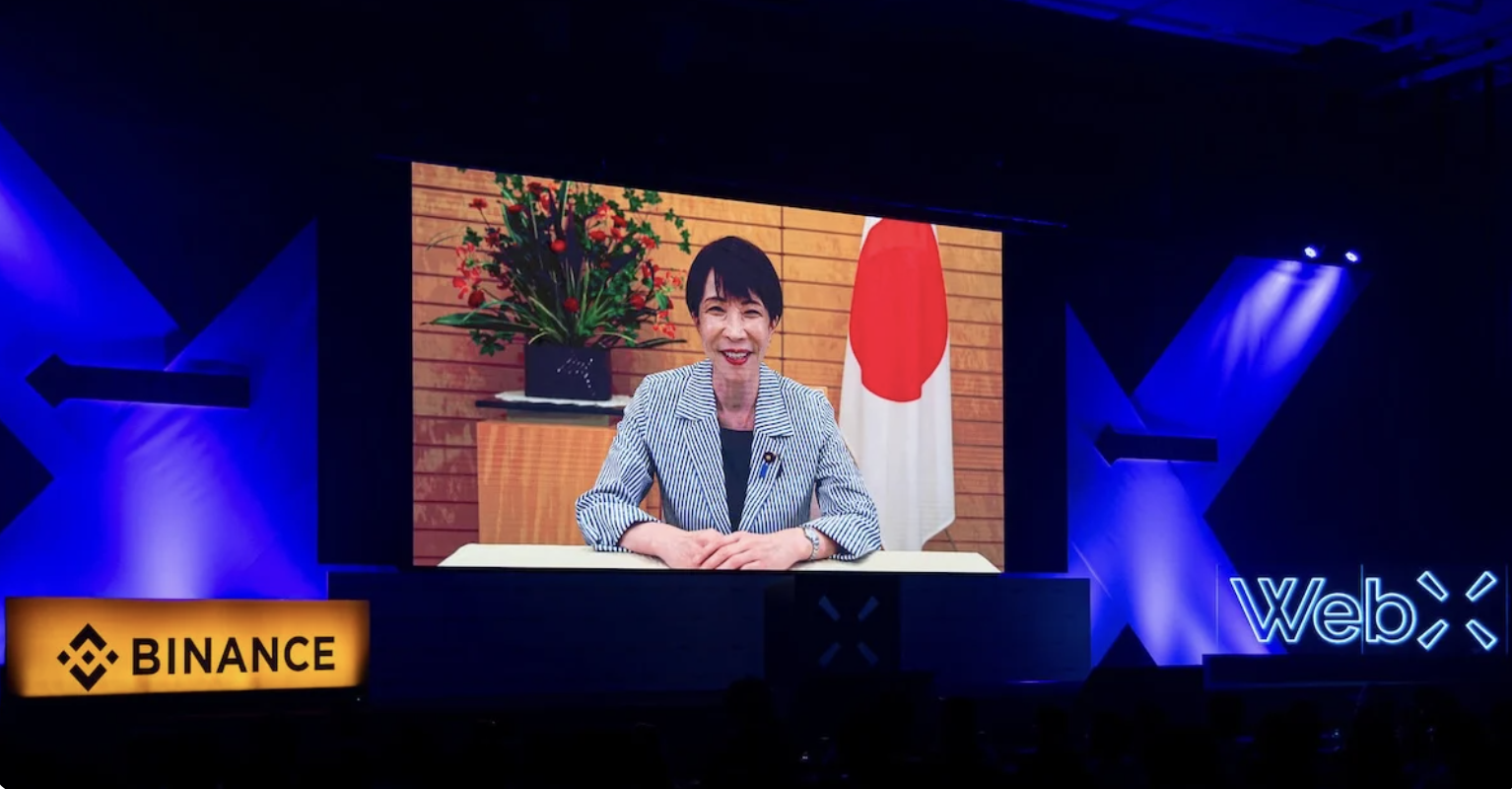
Prime Minister Sanae Takaichi delivered a video address at WebX 2026 on Monday at The Prince Park Tower Tokyo, reaffirming that her government will expand state-backed financial support to Web3 startups as part of Japan’s Comprehensive Startup Support Package. The two-day conference, organized by CoinPost, drew an expected 15,000 participants, making it one of Asia’s largest gatherings of blockchain innovators, institutional investors, and government officials. Economy, Trade and Industry Minister Ryosei Akazawa was also confirmed to address the event.
Takaichi’s pledge arrives as Japan has built more crypto regulatory infrastructure in the past three years than most G7 nations have in a decade — including the world’s first licensed yen-pegged stablecoin, a cabinet-approved reclassification of 105 cryptocurrencies as financial instruments, and a tax reform plan that would cut the maximum capital gains rate on crypto from 55% to 20%. The catch is significant: the 20% rate applies only to “specified crypto assets” traded on licensed domestic exchanges. Staking rewards, DeFi yields, NFT trading income, and all activity on foreign platforms remain taxed as miscellaneous income at rates up to 55% — a structural limitation that Japan’s own crypto industry association has criticized as insufficient.
Japan’s Policy Stack: More Than a Speech
Takaichi’s address was not accompanied by a new fund announcement, a specific grant total, or fresh legal amendments. That is consistent with how Tokyo has approached the sector under three consecutive prime ministers: the government sets a direction, builds infrastructure, and leaves implementation to ministries, regulators, and financial institutions.
What distinguishes this iteration is the infrastructure already in place. Japan’s Comprehensive Startup Support Package, prepared in May 2025 and building on a Five-Year Startup Development Plan adopted in 2022, calls for increased capital from government-backed funds and financial institutions, regulatory changes designed to help young companies grow, and stronger links between startups and established firms. Takaichi’s targets — raising annual startup investment to roughly 10 trillion yen by fiscal 2027, producing 100 unicorn companies, and reaching 100,000 startups nationwide — are longer-term goals that depend on consistent follow-through from an implementing apparatus that the prime minister does not directly control.
The difference from prior years is that Takaichi could point to enacted policy, not just aspiration. Speaking at the same conference in 2024, former Prime Minister Fumio Kishida linked blockchain to social and economic policy from a video feed; in 2025, Shigeru Ishiba appeared in person and backed investment support and rule changes for Web3 and artificial intelligence. This year, the regulatory environment those speeches promised has actually materialized in part.
Japan’s Two-Tier Tax Architecture and What It Means for Builders
Japan’s 2026 Tax Reform Outline, released by the Liberal Democratic Party and the Japan Innovation Party in December 2025, introduced the most significant restructuring of crypto taxation in Japan since the country first licensed exchanges in 2017.
The reform’s formal name is the “specified crypto assets” framework. Gains from spot trading, derivatives, and crypto exchange-traded funds on Financial Instruments and Exchange Act-registered platforms — the so-called “green zone” — will be taxed at a flat 20.315% (15% national income tax, 5% local inhabitant tax, 0.315% reconstruction surtax). That matches the rate applied to stocks and investment trusts, and represents a cut of up to 35 percentage points from the previous maximum.
The corporate side moved first. Starting April 1, 2026, Japanese companies are no longer taxed on the mark-to-market value of long-term cryptocurrency holdings at year-end, eliminating one of the most-criticized structural barriers for institutional treasury adoption.
For individual traders, the flat rate is contingent on the National Diet passing amendments to the Financial Instruments and Exchange Act — amendments submitted in March 2026 and cabinet-approved on April 10, 2026. Japan’s Lower House passed the bill on June 11, 2026; the Upper House must still vote before it becomes law, with Upper House passage widely expected. If enacted, the flat rate would take effect January 1 of the following year, with most projections pointing to 2028 as the earliest implementation date for individuals.
What the reform does not change matters as much as what it does. Activities outside the green zone — including staking rewards, lending income, liquidity pool returns, NFT trading, and all transactions on foreign or unlicensed exchanges — remain classified as miscellaneous income, taxable at progressive rates up to 55%. The Japan Virtual and Crypto Assets Exchange Association has publicly criticized this timeline as too slow. A Web3 protocol developer or DeFi trader based in Tokyo does not benefit from the reform at all unless they exclusively use FSA-licensed domestic exchanges for eligible asset types.
The reform also introduces three-year loss carryforwards for qualifying crypto gains — a provision long available to equity investors but previously absent from the crypto tax code, as detailed in Japan’s 2026 Tax Reform Outline.
Japan’s Stablecoin Framework: A Working Model the G7 Is Still Building
Japan’s regulatory advantage in stablecoins predates Takaichi’s address. Amendments to the Payment Services Act that took effect in June 2023 established what is widely regarded as the world’s first comprehensive fiat-backed stablecoin licensing framework. Issuance is restricted to three types of licensed domestic entities: banks, trust companies, and fund transfer service providers. All must maintain full reserve backing, with assets held in segregated custody.
That framework produced a first: JPYC, Japan’s first licensed yen-pegged stablecoin. JPYC Inc. received its funds-transfer service provider license in August 2025, enabling one-to-one redemption with Japanese yen. Commercial operations launched in October 2025 on Ethereum, Avalanche, and Polygon. JPYC has set an ambitious target of 10 trillion yen in circulation within three years — a scale that would rival some central bank digital currency pilots. Its revenue model depends on interest earned on short-term Japanese government bonds held as reserves, a structure that the Bank of Japan’s recent rate hikes have made viable for the first time.
Japan’s three major banks — MUFG, Mizuho, and SMBC — are separately advancing a joint yen stablecoin pilot on the Progmat ledger platform for business-to-business and cross-border settlement during fiscal 2026, with a dollar-denominated version planned to follow.
The framework does have structural trade-offs. Tether’s USDT, the globally dominant stablecoin, has no licensed domestic sponsor under Japan’s regime and is therefore not distributable through regulated channels. That keeps Japan’s stablecoin market insulated from international liquidity but also from the foreign exchange and payment activity that USDT enables elsewhere in Asia. SBI VC Trade is distributing Circle’s USDC as a licensed Electronic Payment Instrument Exchange Service Provider — the first major global stablecoin to clear that regulatory pathway inside Japan, as detailed under Japan’s stablecoin licensing framework.
ETFs: Filed but Not Approved
The draft article contained an error that requires correction here: Japan has not launched an XRP exchange-traded fund. SBI Holdings filed applications with Japan’s FSA in August 2025 for a spot Bitcoin-and-XRP ETF and a hybrid digital-gold crypto ETF, both targeting the Tokyo Stock Exchange. The FIEA amendment cabinet-approved in April 2026 reclassifies 105 crypto assets — including XRP, Bitcoin, and Ether — as regulated financial instruments, which is the legal prerequisite for ETF eligibility. But the Upper House must still vote on the amendment, and the FSA must finalize its ETF approval framework, with first approvals currently projected no earlier than fiscal 2028.
The investor demand that would flow into those instruments, however, is documented. Between July 2024 and June 2025, Japanese investors put approximately $21.7 billion into XRP alone through centralized exchanges — more than four times what flowed into Bitcoin over the same period — under the current 55% tax regime. SBI Holdings, which holds roughly 9% of Ripple as its largest external shareholder and runs Japan’s only live XRP remittance corridor, began distributing Ripple’s dollar-backed stablecoin RLUSD in Japan on March 31, 2026 — the first Asian market to do so, as documented in SBI Holdings’ XRP and Bitcoin ETF applications.
Japan in G7 Context: The Comparison Holds, With Nuance
Takaichi’s pledge positions Japan as the most explicitly crypto-supportive government among the G7 at a moment when the regulatory map is shifting.
The United States has spent 2026 trying to pass the Digital Asset Market Clarity Act. The bill cleared the House in July 2025 with a 294-134 margin — the strongest congressional endorsement of digital asset legislation in US history — and the Senate Banking Committee advanced it 15-9 in May 2026. As of this writing, it sits at Calendar No. 423 on the Senate floor calendar with no vote scheduled, no cloture motion filed, and three unresolved disputes blocking the seven or more Democratic votes needed to break a filibuster. The effective deadline for Senate passage before the August recess is approximately August 7. Japan, by comparison, has a FIEA amendment that has cleared both the cabinet and the Lower House and is awaiting a final Upper House vote.
The Asia-Pacific contrast is equally pointed. India’s Reserve Bank of India, the central bank that helped establish the Unified Payments Interface — one of the world’s most successful real-time payment systems — told the Parliamentary Standing Committee on Finance on July 2, 2026 that cryptocurrencies pose a threat to an emerging economy and that prohibition remains a recognized option. Government documents reviewed by Reuters in early July indicate the RBI’s formal internal posture remains “leaning toward prohibition,” opposing bank exposure to both foreign and rupee-backed stablecoins. India has approximately 39 million crypto investors holding roughly $2.1 billion in digital assets, operating in a regulatory gray zone without a dedicated framework.
Thailand is moving in a different direction entirely. Bank of Thailand Governor Vitai Ratanakorn announced last week that the central bank is using data-analytics tools to audit abnormally large stablecoin transactions, particularly USDT, targeting suspected money laundering by scam call centers that caused an estimated $3.4 billion in losses in 2025. The crackdown extends to gold trading and foreign exchange. Thailand permits crypto trading but bans its use for payments — a posture that is tightening, not relaxing.
Private capital is flowing into Japan’s regulatory clarity. Ripple partnered with Web3 Salon to offer grants of up to $200,000 for Japanese developers building on the XRP Ledger, with the Japan External Trade Organization as a supporting partner. The target use cases are payments, tokenized assets, and decentralized finance.
The Implementation Question
Takaichi’s address at WebX carries real symbolic weight — the third consecutive sitting prime minister at Asia’s largest blockchain conference is a signal most jurisdictions cannot match. But analysts tracking Japan’s regulatory progress consistently note the same gap: between prime ministerial rhetoric and enacted, disbursed policy.
Japan’s next steps are known. The Upper House must pass the FIEA amendment for the framework to take effect in fiscal 2027 and unlock ETF pathways. The FSA has stated a target of finalizing its stablecoin framework by year-end 2026. The startup funding package must move from policy document to capital that actually reaches early-stage Web3 companies, not just those presenting at WebX. And the individual flat-rate tax, currently projected for 2028, must survive a legislative timeline that the JVCEA considers already too slow.
Koichi Kano, Japan head at cryptocurrency market maker QCP Group, has said the legislation gives market participants “long-awaited clarity.” SBI’s chief executive has separately criticized the pace as “extremely slow.” Both assessments are accurate, and neither contradicts the other: Japan has built more crypto regulatory infrastructure than most peers, and is still moving more slowly than its own industry wants.
For Web3 founders looking at Tokyo as a base of operations, the directional signal is consistent and — given WebX’s three-year record of prime ministerial access — credible. What the directional signal is not, as yet, is a complete delivered framework, a gap covered in depth in Japan’s Web3 policy implementation outlook.
Frequently Asked Questions
Does Japan’s new crypto tax cut apply to DeFi earnings and staking rewards?
No. Japan’s 2026 tax reform introduces a flat 20.315% rate only for “specified crypto assets” — those traded on FSA-licensed domestic exchanges through eligible spot, derivative, or ETF structures. Staking rewards, lending income, liquidity pool returns, NFT trading profits, and all activity on foreign or unregistered exchanges remain classified as miscellaneous income, taxable at progressive rates up to 55%. The Japan Virtual and Crypto Assets Exchange Association has publicly criticized this limitation. A Web3 developer whose income comes primarily from DeFi protocol fees or staking on any platform — including foreign ones — does not benefit from the reform as currently structured.
Has Japan actually launched a crypto ETF?
Not yet. SBI Holdings filed applications with Japan’s Financial Services Agency in August 2025 for a spot Bitcoin-and-XRP ETF on the Tokyo Stock Exchange. Japan’s cabinet approved an amendment to the Financial Instruments and Exchange Act in April 2026 that reclassifies 105 crypto assets as regulated financial instruments — the legal prerequisite. Japan’s Lower House passed the bill on June 11, 2026, but the Upper House must still vote before it becomes law, followed by an FSA approval process. First ETF approvals are currently projected no earlier than fiscal 2028. The market for these products already exists: Japanese investors placed approximately $21.7 billion into XRP alone between July 2024 and June 2025, under the current high-tax regime and without any ETF pathway available.
What is JPYC and why does Japan’s stablecoin framework matter internationally?
JPYC is Japan’s first licensed yen-pegged stablecoin, issued by JPYC Inc. under a funds-transfer service provider license received in August 2025. It launched commercially in October 2025 and runs on Ethereum, Avalanche, and Polygon. Japan’s stablecoin framework — established under Payment Services Act amendments effective June 2023 — restricts issuance to three categories of licensed entities (banks, trust companies, and fund transfer service providers) and requires full reserve backing in segregated custody. That makes Japan one of the only major economies with a working, licensed stablecoin framework that predates Europe’s MiCA. The practical consequence internationally is that USDT, the world’s dominant stablecoin, has no licensed domestic sponsor under Japan’s regime and cannot be distributed through regulated channels — a deliberate design choice that prioritizes stability over external interoperability.
What does Japan’s Web3 posture mean for a developer deciding where to base a startup?
Japan offers genuine structural advantages: a licensed stablecoin framework, a regulatory taxonomy for digital assets that has survived multiple administrations, a historically accessible government (three consecutive prime ministers at WebX), and a tax cut that will — if the Upper House passes the FIEA amendment — cut capital gains on major crypto assets from up to 55% to a flat 20% for trading on licensed exchanges. The structural limitations are also real: DeFi, staking, and foreign-exchange activity remain under the old tax regime; the individual flat-rate tax is projected for 2028, not 2026; and the gap between prime ministerial pledges and disbursed capital has been the consistent cautionary note from analysts since 2024. Singapore and Hong Kong still offer zero capital gains on crypto for individuals. The correct frame is a decision matrix, not a verdict: Japan’s regulatory clarity is genuine and deepening, but incomplete, and meaningfully slower than its own industry wants.
ⓒ 2026 TECHTIMES.com All rights reserved. Do not reproduce without permission.
