
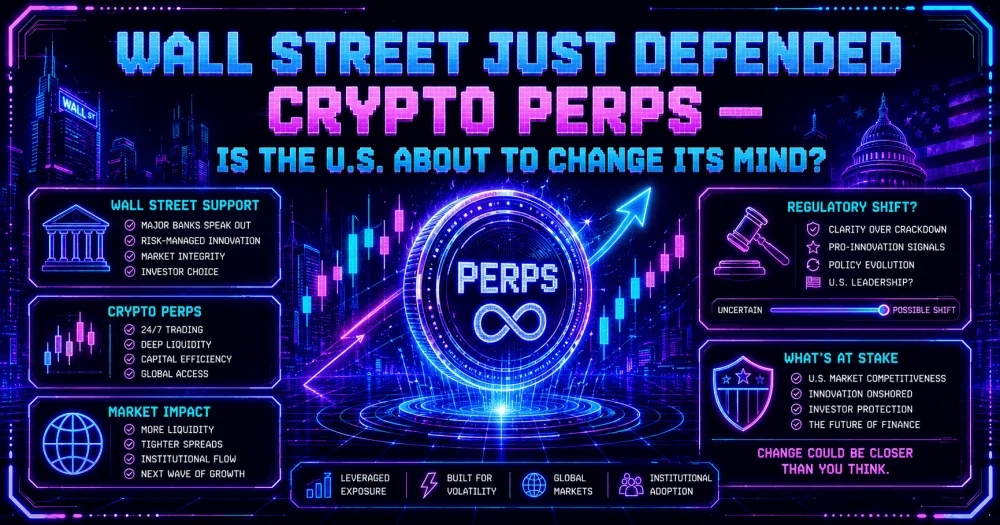

Crypto perpetuals dominate leveraged crypto trading outside the U.S., but that may be about to change. DRW CEO Don Wilson is advocating for perpetuals to be classified as futures. Besides, regulators are already developing clearer paths for both perpetual-style and genuine perpetuals. The debate now focuses on the regulation of crypto perpetual contracts.
What Are Crypto Perpetual Futures and Why Do They Matter?
Crypto perpetual futures are derivatives that allow traders to gain exposure to long or short positions in crypto assets. Unlike standard crypto futures, true perpetual contracts do not have an expiration date. This feature is particularly beneficial for the crypto market. Here, asset values can fluctuate significantly over time, and traders want to maintain exposure beyond weekends.
How Perpetual Futures Work Without Expiration Dates
Unlike standard term contracts, perpetual futures do not have an expiration date. This means positions can be held indefinitely. However, since there is no expiry, perpetuals typically utilize mechanisms such as funding payments to ensure that prices remain close to reference rates.
When the price of a perpetual contract is above the reference price, longs typically pay shorts, and the opposite is true when the price is below the reference. In addition, funding rates can also change depending on whether the perpetual is traded above or below the spot price. This encourages traders to take the opposite position to profit from the discrepancy.
Crypto exchanges are coming for TradFi.
TradFi perpetuals have doubled to >$2B since May.
Binance commands ~35% of crypto-exchange OI in both crypto and TradFi perps. pic.twitter.com/VuPlWrnlUL
— CryptoQuant.com (@cryptoquant_com) July 28, 2026
Why Crypto Traders Prefer Perps Over Traditional Futures
The primary advantage of perpetuals is convenience. Traders who want to maintain exposure to an asset beyond an expiry date do not have to worry about rolling over contracts or buying new ones.
The always-open nature of perpetual contracts also allows longs and shorts to hedge or speculate freely. This allows traders to take advantage of opportunities regardless of the direction of price changes. However, the use of leverage and the possibility of rapid liquidation significantly increase the risks associated with trading perpetuals.
How the Perpetual Futures Market Became Crypto’s Largest Derivatives Sector
Perpetuals were created to satisfy the need for round-the-clock trading, which is crucial for cryptocurrencies. Exchanges outside of the U.S. provided crypto trading instruments that did not require settling positions each quarter or month. Instead, they used funding to keep prices near their reference.
As perpetuals gained popularity and liquidity, market makers and arbitrageurs began joining in. And they brought even more volume and importance to this type of contract. Thus, perpetuals have become an integral part of the crypto derivatives market.
Why Is Wall Street Defending Crypto Perps Now?
Perpetuals are no longer a novelty that only appears in offshore markets. Many traditional trading firms and regulated exchanges now recognize perpetuals as the future of the market.
Don Wilson’s Case Against Current U.S. Regulation
DRW’s Don Wilson believes that perpetual futures should be classified as futures, arguing that removing the expiry date does not qualitatively differentiate perpetuals from other types of standard derivatives.
The essential similarity between perpetuals and other derivatives lies in the fact that they provide exposure to an underlying asset, use leverage, and have an appropriate risk management system. At the same time, product classification is critical in deciding which regulatory frameworks perpetuals should fall under at exchanges.
Why DRW Believes Regulators Misunderstand Perpetual Futures
According to Wilson, the problem is that regulators fail to separate responsible product design from reckless trading practices. The fact that perpetuals typically use leverage is not the main issue, since other derivatives also allow traders to control considerable volumes of assets with relatively small investments.
However, proper regulation of perpetuals, such as appropriate margin requirements, liquidation rules, and market surveillance, should reduce the risks associated with leverage and speculation.
How Crypto Perps Compare to Futures Already Traded in Traditional Finance
Perpetuals and traditional futures have many similarities, as they both require traders to post margin, determine the size of the long or short position, and trade based on an underlying asset. In addition, both types of contracts allow hedging, speculation, arbitrage, and diversification.
However, the critical difference between these derivatives is that standard futures have an expiry date, while perpetuals do not. In addition, the U.S. already has crypto futures, which typically use quarterly expiries. Meanwhile, true perpetual contracts and perpetual-style futures are increasingly being developed and regulated in the U.S. market.
Why Are Crypto Perps Banned or Restricted in the U.S.?
Crypto perps were previously unavailable to most U.S.-based traders on a regulated basis. However, this situation is now changing, as the U.S. now has both perpetual-style and genuine perpetual products for 2025 and 2026, respectively.
The SEC and CFTC’s Approach to Perpetual Futures
Crypto perpetuals were previously unavailable to most U.S.-based traders on a regulated basis. The reason for this was not a blanket ban but rather more nuanced differences in the regulation of derivatives markets. Specifically, the US has more stringent regulations regarding the use of leverage and the listing of new products on centralized exchanges.
However, this does not mean that U.S. regulators do not understand the usefulness of perpetuals. On the contrary, the CFTC has been considering how best to regulate perpetual futures in the crypto market. On the one hand, the CFTC oversees regulated futures markets and wants to bring perpetuals within the framework of existing laws. On the other hand, the SEC has jurisdiction over securities and other types of assets and has taken a more cautious approach to regulating crypto perpetuals.
Why Most U.S. Exchanges Cannot Legally Offer Crypto Perps
A crypto exchange that only provides trading services for spot trading cannot simply start offering leveraged derivatives without first obtaining the appropriate licenses and establishing a clearing and custody system. In addition, it is necessary to introduce appropriate risk management and settlement rules so that the product meets all U.S. regulations.
The Regulatory Concerns Around Leverage and Retail Investor Protection
The main concern of regulators is the risk of excessive leverage. Using 10x leverage, a minor price movement against the trader’s position can lead to significant losses or even a complete loss of the investment. The situation is exacerbated by the fact that liquidation at high leverage can occur due to even smaller price changes in crypto assets, which are known to be highly volatile.
Another issue facing regulators is the potential for market manipulation and the need to establish appropriate price discovery mechanisms for perpetuals. In addition, regulators are concerned about the terms of collateralization, liquidation, funding rates, and transparency.
Could the U.S. Finally Approve Crypto Perpetual Futures?
The U.S. is not only allowing crypto-perps but also preparing to further regulate them. Thus, U.S.-based traders now have access to perpetual-style Bitcoin and Ether futures with regulated clearing in 2025 and the ability to use true perpetuals in 2026.
How the Regulatory Landscape Is Changing Under the Current U.S. Administration
At the federal level, the US is developing clearer guidelines for regulating the crypto industry. The pro-growth policy of the current administration is conducive to establishing the U.S. as a global leader in the crypto market. In particular, the SEC and CFTC have been working closely with industry stakeholders to find solutions for regulating perpetual futures.
The issue of perpetuals demonstrates that regulators are taking a rational approach to the regulation of crypto derivatives markets. Instead of banning such instruments, as some opponents of crypto adoption have been suggesting, the CFTC is studying how best to bring perpetuals within the existing framework.
What Recent Crypto Legislation Means for Derivatives Markets
The debate around crypto perpetuals highlights the need for clear regulations that define which assets fall under the jurisdiction of which agencies. About derivatives, the passage of the CLARITY Act by the House in 2025 and the Senate’s work on the issue in 2026 will help the U.S. develop clearer guidelines for regulating crypto perpetuals and derivatives in general.
Thus, the discussion around crypto perpetuals will most likely lead to a situation where U.S. regulators can provide clearer guidance on how to organize futures, options, and other derivatives trading in crypto.
Which Companies Could Launch Regulated Crypto Perps First
Crypto exchanges that have experience with derivatives trading will benefit from the new regulations. Thus, Coinbase has already begun providing traders with perpetual-style Bitcoin and Ether futures in the U.S. and has also launched regulated institutional access to its crypto derivatives.
Kraken has also announced plans to offer its users U.S.-based perpetual products. In addition, traditional futures exchanges could join the competition, as they have greater experience with derivatives and better infrastructure than crypto-native exchanges.
What Would U.S. Approval Mean for the Crypto Market?
A regulated market for perpetual futures in the U.S. will enable a broader range of traders to gain access to continuous leveraged exposure to crypto assets.
Could Institutional Adoption Accelerate?
Institutions need not only long exposure but also the ability to hedge, short sell, and utilize basis trading strategies. Perpetual futures allow institutional traders to remain continuously exposed to the price of crypto assets without having to roll over expiring contracts.
In addition, regulated perpetual futures will provide institutions with greater liquidity and reduce the risks associated with trading on unregulated platforms. Thus, the introduction of regulated perpetual futures will enable institutional investors, market makers, and other market participants to enter or expand their presence in the crypto market.
How Regulated Perps Could Increase Liquidity and Trading Volume
Greater participation from institutional investors will lead to increased liquidity and trading volumes on crypto exchanges. In particular, regulated perpetual contracts will allow market makers to provide more competitive bid-and-offer prices, as well as contribute to price discovery through arbitrage opportunities.
Arbitrage traders will also play an important role, as they will help perpetuals, spot cryptoassets, ETFs, and dated futures contracts to converge in price. This will reduce the risks associated with trading across different markets while making it easier to hedge positions.
Thus, the introduction of regulated perpetual futures will lead to tighter spreads on crypto exchanges, which will benefit all participants in the market, including small investors.
Why Exchanges Like Coinbase, Kraken and CME Could Benefit
Exchanges that provide traders with access to both spot crypto assets and derivatives will benefit from increased trading volumes and liquidity. Coinbase, for example, can satisfy the demand for leveraged exposure from those who only deal in spot crypto assets.
Kraken also has the potential to compete in this arena as it expands its derivatives offerings in the United States. Meanwhile, the CME Group can benefit from increased trading volumes in futures, as well as the ability to provide institutional clients with access to perpetual contracts.
Despite the differences in their business models, these exchanges will benefit from increased volumes and liquidity in the crypto market.
Will Crypto Perps Become Wall Street’s Next Big Market?
Crypto perpetuals represent a significant opportunity for the traditional financial system.
The Potential Impact on Bitcoin and Ethereum Trading
Bitcoin and Ethereum would benefit the most from a bigger US regulated perpetual futures market as they represent the largest part of crypto derivatives trading at present.
Regulated Bitcoin perps would allow more flexible hedging of BTC▲$62,630.00 positions than rolling over traditional futures contracts. They would also enable greater arbitrage opportunities between Bitcoin spot markets, spot Bitcoin ETFs, and derivatives, helping to narrow discrepancies between prices.
Ethereum would benefit similarly to Bitcoin from the introduction of ETH▲$1,761.17 perpetuals. Trading ETH perpetuals would allow traders to hedge their exposure to price fluctuations of the second-largest cryptocurrency continuously. Traders would be able to combine positions in spot ETH, Ethereum ETFs, options, and dated futures, taking advantage of greater liquidity in derivatives markets.
An increased amount of derivatives trading would lead to better price discovery for both BTC and ETH. At the same time, price volatility for the major cryptocurrencies is likely to grow, especially during periods of high leverage. A rapid crash or rise of prices of Bitcoin or Ethereum due to liquidations in their perpetual contracts could occur, causing abrupt market movements.
Risks That Regulators Still Need to Address
Exchanges and traders must carefully consider potential risks, including leverage, liquidation mechanisms, collateralization, price discovery, and arbitrage opportunities. Regulators should also take into account issues related to market manipulation and the impact on small investors.
Another key risk is related to round-the-clock trading, which means that prices can change dramatically over weekends when traditional banks are closed. Thus, crypto perpetuals require careful risk management on the part of both exchanges and traders so as not to cause undue market fluctuations.
Expert Outlook on the Future of Crypto Derivatives in the U.S.
Crypto perpetuals have come a long way since the early years of the crypto market. Although the initial regulatory environment was not favorable to such products, the situation is changing for the better. Many US-regulated exchanges are looking forward to offering traders new opportunities in the crypto derivatives market.
Regulation of crypto perpetuals will most likely follow the example of other derivatives, such as standard futures, options, and swaps. Thus, perpetuals will most likely fall under the jurisdiction of the CFTC. However, this will depend on the details of the product, including the assets and structures available for trading.
Leverage, funding rates, collateralization, and liquidation rules will be vital in determining how perpetuals are regulated. Moreover, the use of higher leverage may require stricter oversight by regulators so that perpetuals do not lead to excessive speculation.
As for the prospects of crypto perpetuals in the US market, they are promising but far from guaranteed. For perpetuals to succeed in the traditional financial world, they need to be understood and accepted by market participants and regulators. A regulated market with appropriate oversight will allow the advantages of crypto perpetuals to be fully realized.
What Are Crypto Perps?
Crypto perpetuals are derivatives that give long and short exposure to crypto assets, and unlike standard futures, they do not have an expiry date. Funding mechanisms help keep the price of perpetuals close to the reference price.
Are Crypto Perpetual Futures Legal in the U.S.?
Crypto perpetual futures are now legal in the U.S. for certain types of contracts. Some perpetual-style and genuine perpetuals may be available to qualified traders at U.S.-regulated exchanges.
Why Are Perpetual Futures So Popular?
Perpetuals are popular because they can provide continuous exposure to crypto assets and facilitate leveraged trading, hedging, shorting, and arbitrage. Unlike standard term contracts, they do not require traders to roll over expiring positions.
Are Crypto Perps Riskier Than Traditional Futures?
Crypto perpetuals typically involve leverage, which can increase the risks associated with trading such instruments. However, the risks of perpetuals are not qualitatively different from those of standard futures.
Could Regulated Crypto Perps Increase Institutional Adoption?
Regulated crypto perpetuals could facilitate institutional adoption of crypto trading by enabling institutional investors to hedge their positions and take short exposures to crypto assets.
