

Aventus forecasts vary widely. Because AVT has a small market cap and trading volume, as of late August 2026, AVT is priced at about $0.22. According to CoinMarketCap, AVT’s circulating supply is 6 million, and its market cap is approximately $2.1 million.
Aventus (AVT) Price Prediction 2026–2030
Aventus price predictions vary between models predicting price weakness and AVT price at or above $1 in or before 2030.
AVT Price Prediction for 2026
BeInCrypto suggests a range of $0.35 in the bearish case, $1.02 in the bullish case, and $0.61 on average for 2026, while CoinCodex’s prediction model estimates a price closer to $0.45 in late 2026. MEXC’s model gives a range of $0.44-$0.45.
Therefore, AVT price prediction 2026 could vary, and there might not be a definitive AVT price target.
AVT Price Prediction for 2027
Looking ahead to 2027, BeInCrypto’s average price range is between $0.39 and $1.12 with a mean target of $0.68, whereas MEXC’s long-term prediction is $0.46.
The final results by Bybit, however, are closer to the high side of these ranges, predicting that the price will be around $0.62 by 2027. The consensus spread for Aventus AVT price forecast in 2027 is fuzzy but can go close to $1.

AVT Price Prediction for 2028–2030
Longer forecasts have a wider range of predicted prices. BeInCrypto’s 2028 predictions place the average price around $0.74 with a maximum bound of $1.24. MEXC predicts a price of around $0.49 for 2028, $0.51 for 2029, and $0.53 for 2030. However, Gate expects higher prices, forecasting average values of around $0.79, $0.94, and $1.16 for the same years, respectively.
As for the downside, CoinCodex estimates the price would be around $0.17 at the end of 2030. Considering how far apart these projections are, AVT price projection 2030 should be viewed as a set of possible outcomes, instead of a point estimate. At present, predictions range from a major drop to a recovery above $1.
What Is Aventus and What Gives AVT Value?

As a non-profit DAO, Aventus is built for businesses who want to move on-chain, leveraging an ecosystem of enterprise appchains and a decentralized compute infrastructure. The native utility and governance token is AVT.
Aventus claims to have been live since 2017 and to have two production products: Aventus Cloud and Aventus Enterprise Appchains.
As a result, the value of the token is based on demand for such uses of this infrastructure, rather than for use with a single application. As such, Aventus crypto forecast is also conditional on demand for transactions, governance, staking and decentralized compute across the ecosystem.
Aventus Network and Aventus Cloud
Aventus Network has become a Polkadot parachain, but has retained its interoperability with Ethereum. Their Enterprise Appchains are Substrate-based blockchains built around business needs such as privacy, compliance, finality, and transaction logic.
Aventus Cloud has been live on mainnet since April 2026 It is a decentralized compute layer that can interoperate with other blockchains, allowing nodes to perform oracle queries, check summaries of the state, and execute business logic for connected appchains. According to Aventus’s website, more than 2,500 nodes are already live, against a plan of up to 40,000
Your machine is idle right now. It could be doing compute work for enterprise appchains and earning $AVT plus ecosystem tokens for it.
Lock in: https://t.co/wuiyDt9vvOpic.twitter.com/oqV5Qq6mQc
— Aventus DAO: Enterprise Appchains (@AventusNetwork) August 14, 2026
AVT Token Utility and Demand
AVT has multiple use cases within the ecosystem, including for the payment of gas fees, governance, and staking by token holders. Within Aventus Cloud, staking 10,000 AVT increases the number of rewards a node is given. The nodes share a yearly daily reward pool of 14,625 AVT, halved each year
Although these mechanisms tie AVT use to network participation, they do not guarantee price appreciation.
According to the official Aventus website, node rewards depend on network activity, uptime, and the number of nodes. Any Aventus price forecast must therefore consider whether future demand for Aventus tokens will come from adoption and a growing user base, or from a growing number of token emissions.
| AVT Value Driver | Role in the Aventus Ecosystem | Why It Matters |
| Transaction fees | AVT is used to pay gas fees on Aventus Network | Network usage can create utility-driven token demand |
| Governance | AVT holders can participate in DAO governance | Gives the token a role in ecosystem decision-making |
| Staking | AVT can be staked on Aventus Cloud nodes | Connects token ownership with network participation and rewards |
| Aventus Cloud | Provides decentralized compute services for connected blockchains | Cloud adoption could expand AVT-related network activity |
| Enterprise Appchains | Custom blockchain infrastructure for business applications | Enterprise adoption could broaden the ecosystem’s practical use |
What Could Drive AVT Higher?

AVT value depends on the uptake of the underlying infrastructure. Currently, there are two production-grade products: Aventus Cloud and the Enterprise Appchains. In the current instance of the network, AVT is required for transactions, governance, and incentivizing Cloud nodes.
For AVT price target to rise over time, adoption has to mean greater usage of the products and token, which is not guaranteed. Node payouts are determined by a project’s network activity, uptime, and parallel active nodes rather than just on the transaction fees
Aventus Cloud Adoption
Aventus Cloud launched on mainnet in April 2026 to provide a decentralized compute network for oracle queries, state-summary verification and customizable business logic execution. Aventus claims that there are more than 2,500 nodes in operation on Aventus Cloud with capacity for up to 40,000 nodes to be deployed.
Widespread adoption could increase web traffic on the network, but any blockchain with bridged support could connect to the Cloud. Appchains that connect to the network give 3%-5% of their tokens to the network’s node operators
These mechanics do make Cloud adoption a relevant, but very crude, fundamental variable for AVT price target if not the market price itself.
Node operators earn $AVT for compute work. Builders pay $AVT for transactions. Holders vote with $AVT on governance.
One token, three verticals 👀 pic.twitter.com/gjD6QgbI9t
— Aventus DAO: Enterprise Appchains (@AventusNetwork) August 13, 2026
Enterprise and Web3 Growth
Production deployments reference energy, retail, and prediction markets. In one example, Energy Web X, Aventus claims its technology has been used to transfer more than 7.5 million Energy Web tokens
The project partnered with Vodafone’s Digital Asset Broker on enterprise Web3 use cases, and provided the underlying infrastructure for Truth Network, an appchain that powers Galactic’s prediction market technology.
Escalation in enterprise and Web3 use cases would strengthen the case for an Aventus crypto price prediction, but future developments in this space remain speculative.
AVT Staking and Network Activity
AVT directly participates in the rewards mechanism of Aventus Cloud such that staking 10,000 AVT in a node doubles the base reward weight it receives. The daily AVT distribution is 14,625 per node in Year 1. This AVT emissions reduces by half every year.
According to Aventus, staking temporarily removes those AVT coins from circulation. AVT is also needed on Aventus Network as gas for transactions and to vote in its DAO-based governance.
These utilities mean that higher staking participation and transaction activity could affect token demand and free float, two factors relevant to the longer-term Aventus crypto forecast.
| Growth Factor | Current Indicator | Potential Impact on AVT |
| Aventus Cloud adoption | 2,500+ active nodes; capacity for up to 40,000 | More network usage could increase demand for AVT-related utility |
| Enterprise adoption | Deployments across energy, retail and prediction markets | More enterprise use cases could expand ecosystem activity |
| AVT staking | 10,000 AVT doubles a Cloud node’s base reward weight | Higher staking participation can reduce freely circulating supply |
| Network activity | AVT is used for gas, governance and Cloud incentives | Greater activity could increase practical token demand |
| Appchain growth | Connected appchains allocate 3%–5% of their tokens to node operators | More integrations could strengthen Cloud participation and incentives |
AVT Price Forecast: Bullish vs. Bearish Scenarios
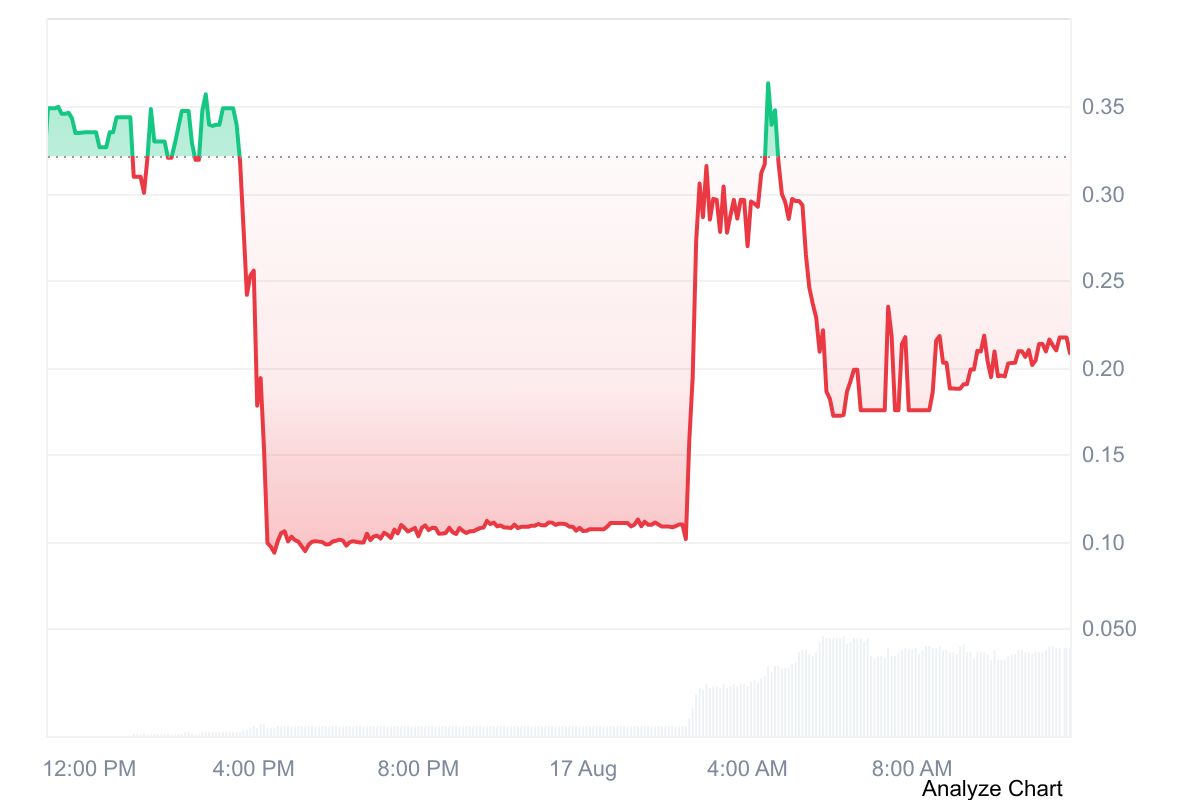
AVT’s price is sensitive to adoption and liquidity. At one point, the website CoinGecko listed Aventus at $0.22 with a $2.1 million market capitalization, when the price had fallen considerably.
Despite this small valuation allowing for both positive and negative upside, it means any AVT $1 price prediction is heavily reliant on demand maintaining rather than circumstantial price movements.
What Could Send AVT Toward $1?
There are more optimistic scenarios, with Aventus ecosystem utilization increasing. Aventus Cloud has been running on mainnet since April 2026 with over 2,500 live nodes and a target of 40,000 nodes.
The network’s services include decentralized oracle, state-summary verification, and the execution of custom business logic; Aventus says appchains following its specification can connect to the Cloud and gain access to these services.
AVT has further uses, for example paying gas fees on Aventus Network, and in governance and staking on Cloud nodes. Staking a fixed 10,000 AVT on each node of Aventus protocol doubles the base reward weight of the node, incentivizing token holding as the node network grows.
In assessing can AVT reach $1, growing Cloud adoption alongside greater staking and transaction activity would therefore be among the fundamental developments to watch.
What Could Keep AVT Below $1?
For the bear case, we will start with the current market information about the coin AVT. CoinMarketCap estimates AVT market cap to be $2.1 million and the circulating supply to be around 9.9 million AVT. However, Aventus states that the total supply AVT is around 12.54 million.
Token minting is also considered. For instance, Aventus Cloud distributes 14,625 AVT daily to active nodes in Year 1, halving each year. Aventus also notes that rewards are dependent on network activity, uptime, and active node count and are not guaranteed.
If ecosystem usage fails to grow sufficiently alongside token distribution, the bullish AVT price target would have less fundamental support.
Can Aventus (AVT) Reach $1?

AVT needed to reach $1 from its then-current market price of about $0.22, which would be a 4.6 increase. AVT number available in circulation at the time, about 9.9 million, created a market valuation of $2.1 million. The circulated AVT supply changes as AVT enters and exits circulation.
The question of can AVT reach $1 thus becomes whether Aventus can attract and sustain sufficient demand. The all-time high AVT price according to CoinGecko was $10.25. However, just because a price has occurred before does not mean it will happen again.
The Market Cap AVT Would Need at $1
Using CoinGecko’s current circulating-supply estimate of 9.9 million AVT, a $1 token price would imply a market capitalization of approximately $9.9 million. For comparison, market analysis currently values the circulating supply at about $2.1 million.
Supply is an important caveat for any Aventus AVT forecast. Aventus itself reports 12,544,941 AVT issued and distinguishes total supply from circulating supply because tokens may be staked, locked, or otherwise unavailable for trading.
The protocol also rewards active Cloud nodes with 14,625 AVT per day over Year 1, halved every subsequent year.
Reasons to be bullish on Aventus:
• Building since 2017 through every market cycle.
• Enterprise relationships with organizations like Vodafone, Heathrow and Ticketmaster.
• Listed on Coinbase.
• A growing ecosystem built around huge business use cases.
• Aventus Cloud… pic.twitter.com/pzshQQZIHH
— Aventus DAO: Enterprise Appchains (@AventusNetwork) August 4, 2026
How Realistic Is a $1 AVT Price by 2030?
Returning to $1 by 2030 is mathematically possible, but not likely based on the above metrics alone. Aventus Cloud mainnet was not launched until April 2026, and there are 2,500 nodes running at the moment while the final number is intended to be 40,000.
Similarly, the metrics of cloud adoption, connected appchains and demand for AVT staking could provide further indications of network growth.
Also, AVT forecast 2030 is much more reliant on the market; at the time of writing, CoinGecko puts AVT around 98% off its all-time price peak.
While a $1 price isn’t incompatible with a large-cap valuation at today’s supply, achieving and maintaining this price would likely require a considerable recovery in demand across the market.
Aventus (AVT) Price Prediction 2030

A long-range Aventus price prediction 2030 carries substantial uncertainty because Aventus Cloud has only been live on mainnet since April 2026. The network currently has more than 2,500 active nodes, with Aventus targeting capacity of up to 40,000.
Its infrastructure also includes Enterprise Appchains for areas such as energy, retail and prediction markets, known as Aventus Cloud.
While AVT now trades at less than $1, it would need to approach this price level by 2030. Price history is one of the arguments for AVT appreciation, but the longer-term argument rests on Aventus delivering real network activity and translating that into AVT demand.
What Could Determine AVT’s Long-Term Price?
Aventus Cloud adoption is a major consideration, as nodes will handle oracle requests, state summary validation, and business logic for appchains. Aventus states that compatible blockchains can use the infrastructure; however, appchains connected to Aventus Cloud will pay 3% – 5% of their token supply to nodes
Another factor is its token economics, where AVT is used to pay for transaction fees and for governance and staking. Staking 10,000 AVT on a Cloud node doubles the base reward weight.
Simultaneously, from the project perspective, cloud incentives create AVT tokens. These are initially awarded at a rate of 14,625 AVT per day in Year 1, but halve annually. These supply and demand mechanics would be relevant to an AVT price prediction 2030.
Aventus has been building long enough to watch multiple crypto narratives come and go.
NFTs.
The Metaverse.
Play-to-earn.
One thing has remained constant.
Businesses still need infrastructure they can depend on. pic.twitter.com/lAp4ijxAFl
— Aventus DAO: Enterprise Appchains (@AventusNetwork) July 23, 2026
AVT’s Potential Upside From Current Levels
At $-.20-$0.25 market price, a $1 token price is a 4x-5x market cap multiple. This is a material IRR percentage; however, on an absolute crypto market basis, the implied valuation is small given that AVT has a circulating supply of ~10 million tokens.
Price appreciation alone, however, would not show that the recovery is sustainable, as Aventus explicitly states that Cloud node rewards vary with network activity, uptime, and the number of participating nodes.
Alternatively, if Cloud, appchains, staking and transacting on the platform were to become widely adopted, then it could be plausible to see a $1 Aventus AVT price target by 2030.
| 2030 Scenario | What Could Drive It | Potential AVT Impact |
| Bearish | Weak Cloud adoption, limited appchain growth, low token demand | AVT could remain well below $1 |
| Base case | Gradual network growth and continued staking activity | AVT could recover from current levels without reaching $1 |
| Bullish | Strong Cloud adoption, more appchains and higher AVT usage | AVT could move closer to the $1 target |
| $1 scenario | Sustained ecosystem growth combined with stronger token demand | At ~10M circulating AVT, $1 implies roughly a $10M market cap |
Is AVT a Good Investment?

Whether is AVT a good investment depends largely on an investor’s tolerance for the risks of a small-cap token tied to an early-stage infrastructure ecosystem.
Its clear use of network gas for fee-paying, governance, and staking for Cloud nodes provides some assurance for use. Aventus Cloud and Enterprise Appchains are both functional.
A major downside is the intrinsic market risk: current trading data indicate AVT has a market capitalization of around $1.3 million, and that its market price is characterized by important price fluctuations. Therefore, its business case is very much speculative, despite existing infrastructure.
The Bull Case for Aventus
The bullish thesis is adoption, and as of April 2026 more than 2,500 nodes have gone live on mainnet for Aventus Cloud, and it is planned for scaling to 40,000. The infrastructure provides decentralized oracle, summary verification, and execution of custom business logic to compatible blockchains.
AVT lies in the ecosystem as well: if 10,000 AVT are staked on a Cloud node, its base reward weight doubles, AVT holders can participate in the DAO, and AVT are used as fees. These functions provide AVT with utility beyond trading on the secondary market, dependent on network participation and adoption.
$AVT is knocking on that daily 200.
Bulls reclaim this level and things could get interesting.
One thing I like about Aventus is it isn’t trying to be another hype driven L2. It’s focused on enterprise adoption, tokenization, and real-world infrastructure.
In my opinion, that… pic.twitter.com/HC363nB5pC
— Z (@crypto_zacho) July 9, 2026
The Biggest Risks for AVT Holders
Liquidity and volatility are also issues to consider. For example, because AVT market cap is relatively small, buying and selling even small amounts of it will cause a large percentage movement in its price. One recent example of rapid market loss was when AVT’s market dropped over 10% in a single day.
Token supply is also an important factor for price discovery. Aventus state 12.54 million AVT are in circulation, and 14,625 AVT are minted each day, becoming halved each subsequent year thereafter. Total emissions of AVT are estimated to be around 10.68 million AVT. The reward model can also be adjusted.
Finally, the project notes that the amount of Cloud rewards changes dynamically based on network conditions and the Cloud node’s uptime and volume of active nodes. This leaves AVT susceptible to the volatility of the cryptocurrency market, as well as the execution risk of Aventus Cloud adoption.
What Is Aventus (AVT)?
Aventus is a suite of blockchain infrastructures for enterprise application-specific blockchain networks, as well as for decentralized compute through Aventus Cloud. AVT, its native token, is used for fees, governance, and staking.
What Is the Current Price of Aventus?
As AVT’s price is being constantly updated based on buys, sells, and liquidity of exchanges that support trading with the token, investors should verify real-time market data.
What Is Aventus Cloud Used For?
Aventus Cloud is a decentralized compute network to execute oracle queries, verify state summaries, and deploy business logic to any compatible blockchain network.
Does Aventus Support AVT Staking?
Yes, AVT can be staked on Aventus Cloud nodes, and is included in the calculation of a node’s reward weight. Rewards are determined by a variety of factors, including network activity, uptime, and number of nodes.
What Factors Could Affect the Future Price of AVT?
Key factors affecting AVT’s price include adoption and enterprise appchain utilization on Aventus Cloud, staking behavior, AVT supply and emissions, liquidity, and general conditions in the cryptocurrency market.
