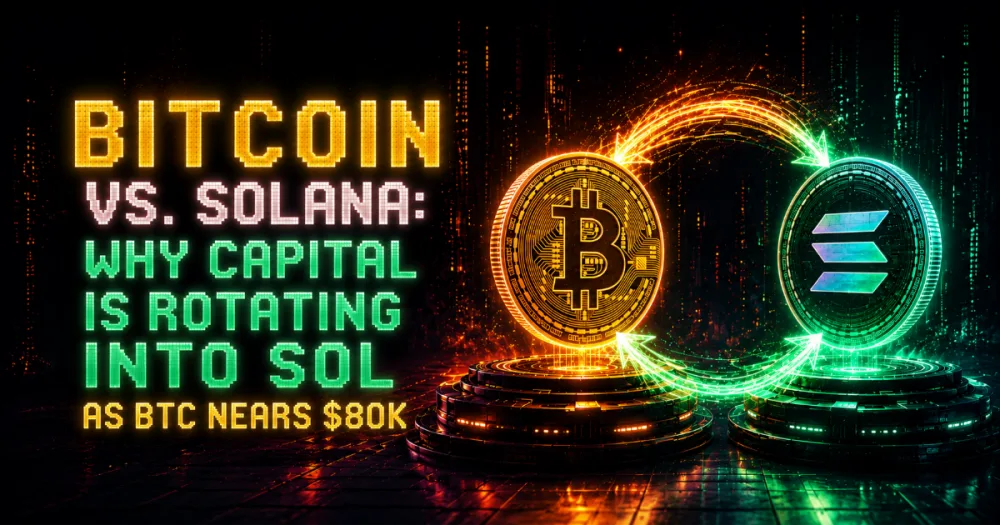

Bitcoin vs. Solana: Is Capital Really Rotating Into SOL?
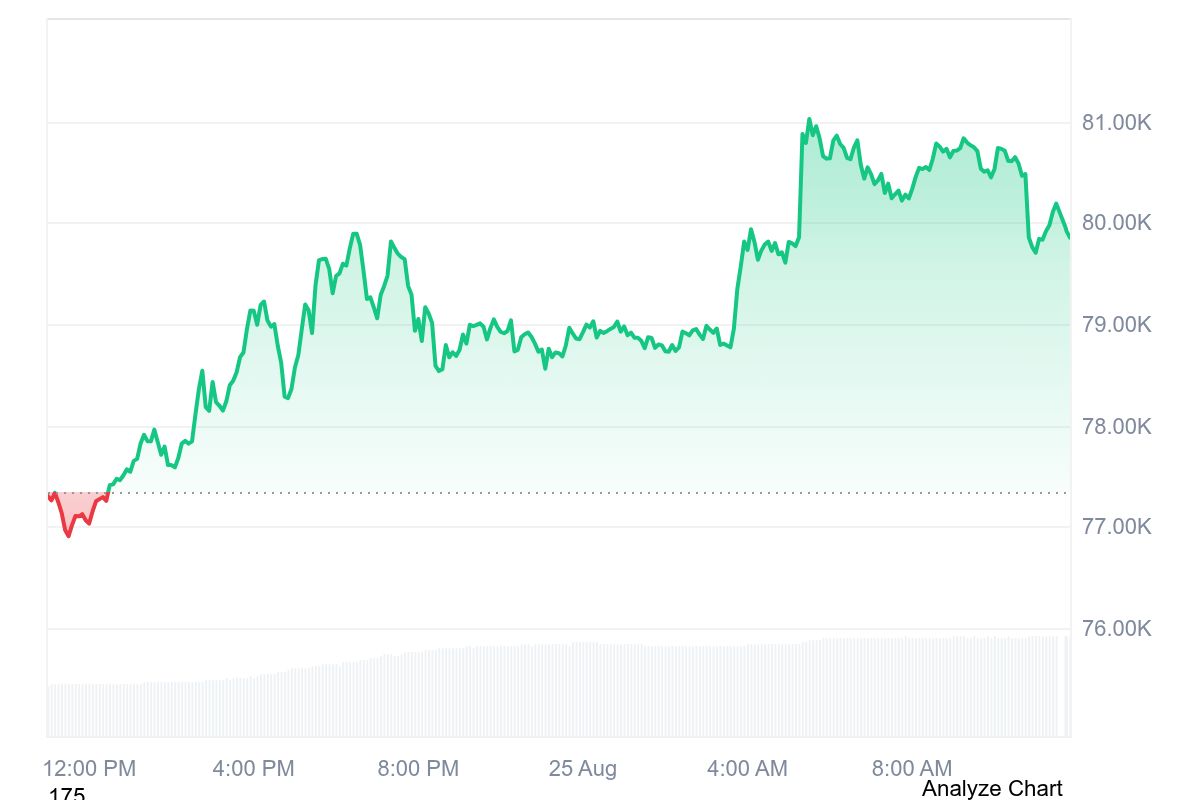
Bitcoin has crossed $80,000, and Solana has moved to $100 BTC▲$62,630.00 has a value of $80,077. In a similar way, SOL▲$82.41 has a value of $100.57. The prices of Bitcoin and Solana are both growing, but SOL is growing much faster than BTC
Bitcoin Nears $80K as Institutional Demand Returns
The resurgence of US spot ETF demand occurred concurrently with Bitcoin’s rally. Farside Investors data reported combined Bitcoin ETF inflows on August 24 reached $208.9 million, following around $1.6 billion of inflows the previous week. Bitcoin remains the major store of institutional crypto capital.
Bitcoin subsequently peaked at over $79,000, its highest value in three months, before slipping back below the $80,000 mark. Both values still remain below the October 2025 all-time high of over $126,000, but are considered a large recovery rather than a new all-time high.
JUST IN: $80,834 Bitcoin! 🚀 pic.twitter.com/1Ouoi92RmA
— Bitcoin Magazine (@BitcoinMagazine) August 25, 2026
Why Solana Is Starting to Capture More Investor Attention
Solana is also seeing institutional demand, with U.S. spot Solana (ETFs seeing around $14.59 million of net inflow on August 21 and $1.15 billion worth of net inflows total, suggesting longer-term institutional access to SOL.
Supporting this thesis is the data that, according to data aggregator DefiLlama, the amount of stablecoins locked in Solana, as well as DEX volume over a week, are $15.94 billion and $19.74 billion, respectively.
Capital Rotation vs. Broad Crypto Market Rally
Just because SOL is outperforming BTC doesn’t mean investors are leaving other assets to buy Solana. Data suggests that crypto assets had co-demand: on August 24, US-listed Bitcoin, Ether, Solana and Hyperliquid products all had nearly $192.6M in demand.
As things stand, while potential crypto capital rotation can be viewed as a trend, it can hardly be described as a BTC-to-SOL movement, given the magnitude of institutional capital in Bitcoin and the fact that Solana’s ETF flows are smaller, with better short-term performance and activity.
| Metric | Bitcoin (BTC) | Solana (SOL) | What It Signals |
| Price | ~$80,077 | ~$100.57 | Both assets are participating in the rally |
| Recent ETF Flow | $208.9M on Aug. 24 | $14.59M on Aug. 21 | Institutional demand remains much larger for BTC |
| Institutional Position | Established market leader | Growing ETF access | SOL interest is rising from a smaller base |
| On-Chain Catalyst | Primarily monetary/investment demand | $15.94B stablecoins; $19.74B 7-day DEX volume | SOL has additional ecosystem-driven demand |
| Rotation Signal | Strong inflows continue | Stronger short-term momentum | Evidence favors broader crypto demand over a confirmed BTC-to-SOL rotation |
Bitcoin vs. Solana: How the Two Assets Compare in 2026
As a result, the Bitcoin Solana comparison is more about what the assets represent, Bitcoin often being seen as scarce money with institutional infrastructure and Solana’s ecosystem more around usage, DeFi, trading, and applications, rather than any meaningful comparison of their nominal price per token.
Bitcoin’s Institutional and Store-of-Value Narrative
August provided a second influx of Bitcoin narratives, including $1.6 billion in inflows to spot Bitcoin ETFs in the United States between August 17 and August 20, with Bitcoin pricing over $80,000 for the first time in three months. Recent media reports have linked this rally to ETF demand, a weaker dollar, and renewed interest in alternative stores of value.
Scarcity continues to be an important part of Bitcoin vs. Solana 2026. The maximum Bitcoin supply is capped at 21 million BTC, with 20.01 million BTC in circulation as of March 31, 2026. A well-defined issuance schedule and specialized investment products make an institutional case for Bitcoin as a store of value.
Solana’s Growth, DeFi and High-Throughput Narrative
Solana, by contrast, has a thesis that is more tied to decentralized exchanges, lending protocols, stablecoins and other apps that take place on-chain.
DeFi analytics still rank these networks by metrics like TVL, fees and trading activity, so the actual usage of the blockchain is still an important part of Solana’s ecosystem.
Institutional adoption has continued, with US Solana ETFs receiving approximately $1.15 billion in net flows as of the latest dataset. Another $14.6 million had been recorded on August 20. That gives the Solana vs Bitcoin 2026 comparison an institutional dimension, although Solana ETF flows are much less than Bitcoin’s.
BTC vs. SOL Market Performance and Relative Strength
Both have also seen price increases for different reasons in recent weeks. On August 25, Bitcoin crossed the $80,000 mark, having gained 28% in August and on the cusp of the largest monthly gain since November 2024. This came on the back of renewed institutional demand and macro conditions for alternatives.
BTC vs SOL short-term relative performance should, however, be separated from their long-term narratives: BTC offers stronger institutional and scarcity narratives, while SOL offers more exposure to activity in a high-usage smart-contract ecosystem. The difference in their performance may well be because investors are buying fundamentally different types of crypto exposure.
Why Investors Are Looking at Solana as Bitcoin Rallies

Bitcoin price has recovered and driven the rest of the cryptocurrency markets upward. Solana is popular not just for institutional products but also for healthy on-chain markets, with Solana enjoying a parallel growth trajectory along with demand for Bitcoin rather than a complete substitute.
Solana ETF Flows Signal Growing Institutional Interest
According to Farside Investors, the U.S. Solana ETFs attracted $1.15 billion in net flows. On August 10, the combined net flow was $8.8 million, and on August 20, it was $14.6 million. This suggests Solana institutional investment inflow through regulated vehicles.
The relative lack of flow though, suggests that while the institutional market has begun to emerge, demand has yet to pick up considerably, as evidenced by days of zero flow in August.
Solana’s DEX Activity and On-Chain Growth
The decentralized exchanges remain one of the strongest sectors of Solana ecosystem. According to DefiLlama, Solana DEX volumes are currently $1.06 billion in the last 24 hours and $43.14 billion for the last 30 days. Pump and Orca are some of the largest DEXs.
For DEX aggregators, Solana’s 30-day trade volume of $18.8 billion, with much of the volume concentrated on Jupiter and DFlow, also makes sense of why people are watching both network activity and SOL price action.
Looking at $BTC near $80K, $ETH around $2,500, and $SOL around $100, I’m honestly worried about people buying here.
This is not a bull market. Just a few weeks ago, everyone was talking about a bear market, even CZ said that we are in a bear market, but then Trump made some… pic.twitter.com/8TXnXkLpdB
— Crypto with Haris ₿ (@Crypto__Haris) August 25, 2026
The Search for Higher-Beta Exposure to Crypto
In general, SOL was more volatile to cryptocurrency price shocks than Bitcoin. A July Morgan Stanley report showed SOL to be about 44% more volatile than Bitcoin since the beginning of 2026, making SOL riskier than Bitcoin.
These price moves can create higher profits or losses (in July, with Bitcoin approaching $62,000, Solana surged close to 19% in a week during Bitcoin’s recent rally); Solana can offer higher volatility and, therefore, risk to investors who want more exposure to high-beta assets during stronger markets.
Bitcoin ETF Flows vs. Solana ETF Flows
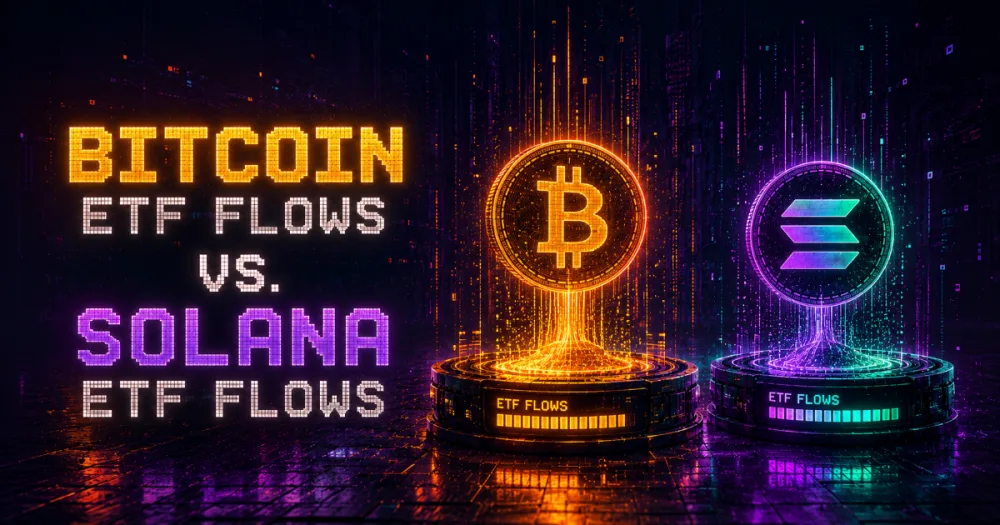
However, per ETF data, the demand for Bitcoin ETFs is more pronounced than for Solana, which has seen net inflows of $1.15 billion, whereas US spot Bitcoin ETFs have seen $53.5 billion. That gap is central to the Bitcoin vs Solana ETF comparison.
Where Institutional Capital Is Going
To illustrate the difference in interest, Bitcoin ETFs recorded inflows of $297.5 million on August 17, $189.3 million on August 18, $517.2 million on August 19 and $606.3 million on August 20. Solana products recorded inflows of $1.6 million, $2.5 million and $14.6 million on 18, 19 and 20 August.
These data indicate institutional capital is entering SOL, although Solana ETF inflows pale in comparison to Bitcoin exchange-traded products.
Why BTC Still Dominates Institutional Crypto Allocations
Bitcoin’s advantage is most clear in cumulative flows, where since launch, US spot Bitcoin ETFs saw $53.5 billion in flows, compared to BlackRock’s IBIT seeing $62.2 billion in flows after accounting for all other flows.
For Solana, cumulative net flows across all ETFs are only $1.15 billion, but BTC is further entrenched in institutional hands, while SOL is continuing to grow in regulated spaces.
BlackRock Leads $338 Million Bitcoin ETF Inflow as Ether Funds Add $116 Million
U.S. spot Bitcoin ETFs recorded $338 million in net inflows on Aug. 24, led by BlackRock’s IBIT with $209 million, while spot Ether ETFs attracted $116 million, with BlackRock’s ETHA accounting for… pic.twitter.com/vd38qplHpR
— Wu Blockchain (@WuBlockchain) August 25, 2026
What the SOL Inflows Say About Risk Appetite
Nevertheless, there was interest outside of the two largest crypto assets, with Solana ETFs netting $14.6 million on August 20, their largest daily total in the past week, and also net positive on August 18 and August 19, although by smaller amounts.
This underpins the story of a slowly growing SOL vs BTC – there is evidence of slightly more institutional interest in SOL, although the existing BTC ETF data doesn’t show a SOL-BTC flip. Investors are adding small, speculative altcoins, but still allocating hefty amounts to BTC.
| Metric | Bitcoin ETFs | Solana ETFs |
| Cumulative Net Flows | ~$53.5B | ~$1.15B |
| Aug. 18 Net Flows | +$189.3M | +$1.6M |
| Aug. 19 Net Flows | +$517.2M | +$2.5M |
| Aug. 20 Net Flows | +$606.3M | +$14.6M |
| Institutional Position | Dominant | Growing, but much smaller |
Solana’s Fundamentals Are Strengthening the Rotation Narrative
Measured activity on the network provides support for the case for capital rotation into Solana. The network has large decentralized trading volumes, growing DeFi liquidity, and strong stablecoin liquidity. Ultimately, capital rotation to Solana has fundamentals aside from SOL performance.
Solana’s Share of Decentralized Exchange Activity
Solana currently has the most spot DEX trading activity of any major chain, at $20.5 billion in seven-day volume and $55.9 billion in 30-day volume, compared to $11.5 billion and $29.8 billion on Ethereum, respectively.
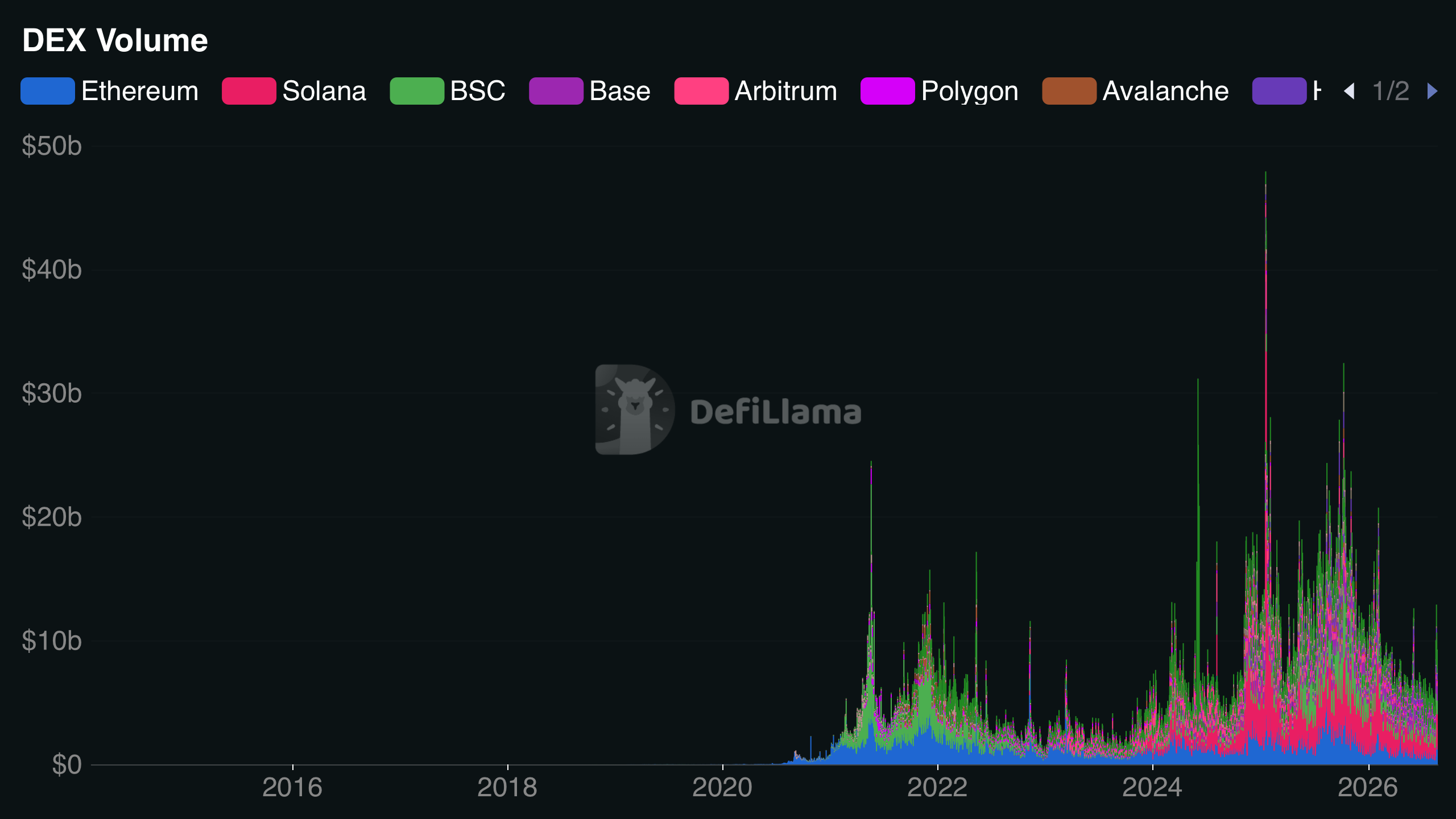
That is important because decentralized exchanges are one of the largestranked of these DEXs fluctuates with market conditions, Solana currently ranks higher than Ethereum, BSC, and Base on 30-day DEX volume
DeFi, Stablecoins and Network Activity
On a wider scale, Solana has $5.8 billion in total value locked (TVL) in decentralized finance, and $15.9 billion in stablecoins. In the most recent 24-hour period, there were some 109 million transactions across the network for 2.7 million addresses.
The liquidity, stablecoin supply, and historical stablecoin on-chain activity provide metrics to show the growth of the ecosystem, giving more information to investors beyond just the token price. This makes Solana’s fundamentals more relevant in the Bitcoin vs Solana battle.
SOL’s Role as the Core Asset of the Solana Ecosystem
SOL is used for transactions on the network, such that every recorded transaction on Solana has a base transaction fee in SOL, and users can pay a priority fee to have their transactions prioritized. Half of the base fee is burned, while the other half is sent to the block-producing validator.
SOL is also used for staking, which helps secure the network. SOL holders are able to delegate their SOL to validators to help secure consensus and earn staking rewards. This fee-staking system creates a direct demand for SOL by tying it to Solana network.
What Could Stop Capital From Rotating Into SOL?

There are clear limits to rotation, as Bitcoin continues to enjoy sizable institutional inflows, and the fact that SOL has higher volatility and additional network, ecosystem, and regulatory risks relative to Bitcoin may limit the extent to which investors are willing to move along the crypto risk curve.
Bitcoin’s Strong Institutional Demand
Bitcoin remains difficult to dethrone as the preeminent institutional crypto asset. US spot Bitcoin ETFs received $297.5 million, $189.3 million, $517.2 million, $606.3 million and $307.5 million in net inflows during the week of August 17-21. The total cumulative net flows were about $53.8 billion.
Nonetheless, it suggests that institutional investors are far from wholesale rotating BTC exposure into SOL. Bitcoin demand could coexist with increasing interest in Solana, limiting the performance impact of a Solana vs Bitcoin 2026 rotation.
Solana’s Higher Volatility and Risk Profile
While SOL is said to have more upside than Bitcoin, SOL carries much higher price risk. At the time of analysis in July, SOL was reportedly 44% more volatile than Bitcoin since January 2026.
This could be a key factor in Bitcoin vs Solana investment, as BTC may be preferred for defensive investors. Investors with a lower risk appetite may not find SOL volatility appealing.
SOLANA WAS SCREAMING BOTTOM WHILE EVERYONE IS STILL PANICKING $SOL Percent Supply in Profit hit the same extreme zone as the 2022 cycle bottom.
data reached the bottom zone before confidence returned.
That is usually how these opportunities appear. Price turns first. Belief… https://t.co/j5GTXRzLpQpic.twitter.com/GQEgM28WW7
— Cryptollica (@Cryptollica) August 25, 2026
Regulatory, Network and Ecosystem Risks
SEC filings for SOL-linked investment products have cited regulatory uncertainty, risks associated with cybersecurity, and outages of Solana network as risk factors, noting that network instability or unfavorable regulatory developments could obstruct adoption and negatively impact SOL prices.
Possible risk factors include software bugs in open-tion, and outages of trading venues. Although these are not guaranteed to occur, they are examples of weaknesses that could chill demand for SOL and disrupt an extended trend of capital rotation
| Factor | Bitcoin (BTC) | Solana (SOL) | Impact on Rotation |
| Institutional Demand | Strong; ~$53.8B cumulative ETF net flows | Growing from a smaller base | Favors BTC |
| Relative Volatility | Lower | ~44% higher than BTC* | Raises SOL risk |
| Network Risk | Comparatively limited application-layer exposure | Smart-contract and network risks | Raises SOL risk |
| Regulatory Risk | Established U.S. spot ETF market | Regulatory uncertainty cited in SOL product filings | Could restrain demand |
| Investor Profile | More defensive crypto exposure | Higher-beta exposure | Rotation depends on risk appetite |
Bitcoin vs. Solana: Which Asset Has the Stronger Setup Now?
Bitcoin vs Solana investment case is not the same: Bitcoin has more support from institutions and a better macro backdrop, while Solana has to marry emerging ETF demand with exposure to a more active smart-contract ecosystem.
The Bull Case for Bitcoin
On 25 August, Bitcoin rose above $80,000 to a three-month high, with a 28% rise during the month. As per Reuters, the rally was due to a weaker U.S. dollar, lower long-term yields, and an uptick in investment interest in Bitcoin, gold, and other assets.
At the same time, demand for ETFs was strong. Over 3 days — August 4-6— the U.S. spot Bitcoin ETFs saw net inflows of $211.5 million, $244.4 million, and $137.6 million before seeing outflows in the subsequent days.
DID THE US TREASURY JUST START THE NEXT BITCOIN BULL RUN? 🤯
On August 19 they doubled long-term bond buybacks to stop yields from climbing.
Bitcoin is up 26% since.
Investors are concerned about a weakening dollar and rising inflation, driving a massive rotation into hard… pic.twitter.com/z6lYWFu7cd
— Crypto Rover (@cryptorover) August 25, 2026
The Bull Case for Solana
Solana’s case rests on regulated access. U.S. Solana ETFs have brought $1.15 billion in net inflows, including $14.6 million on August 20. Bitwise’s BSOL was responsible for most of the total, showing that institutional demand was notably concentrated.
SOL also has exposure to the general application landscape. Solana boasts a larger total value locked, fees, and other decentralized-finance activity than Ethereum or other major Layer 1 chains, a key part of its narrative.
Why Investors May Choose BTC and SOL Instead of One Over the Other
The Bitcoin vs Solana which is better question can overlook their different roles. Such comparisons don’t consider Bitcoin’s institutional infrastructure or exposure to the digital scarcity narrative, or Solana’s exposure to smart contract applications and the emerging ETF market.
Data on flows into and out of different products, however, show demand for each. Flows into Bitcoin and Solana-linked products have both increased over the past few years.
BTC and SOL can be a way for investors with different risk appetites to gain exposure to crypto. Data shows there are deeper roots of institutional interest in Bitcoin than in Solana, although the latter has seen far more growing regulated demand.
| Factor | Bitcoin (BTC) | Solana (SOL) |
| Core Investment Case | Digital scarcity and institutional adoption | Smart-contract ecosystem growth |
| Institutional Access | Deep U.S. spot ETF market | Growing Solana ETF market |
| Current Catalyst | ETF demand and supportive macro conditions | ETF inflows and ecosystem activity |
| On-Chain Narrative | Monetary and store-of-value focus | DeFi, applications and network usage |
| Risk Profile | Relatively lower-risk crypto exposure | Higher-beta, higher-volatility exposure |
| Strongest Argument | Institutional depth | Greater exposure to ecosystem growth |
What to Watch Next for BTC and SOL
When it comes to Bitcoin vs Solana performance, the next chapter will be written by institutional flows (or the lack thereof) and by SOL activity supporting the strength we’ve seen recently. Here, ETF flows, BTC dominance, SOL/BTC, and decentralized volumes tell us more than price.
Bitcoin ETF Net Flows
Institutional demand can also be gauged through Bitcoin ETF flows. In the U.S. spot, flows saw greater volatility this week, from $144.6 million of outflows on August 10 to more modest inflows the following day. Earlier in August, there were days when over $100 million was poured into these U.S. spot ETFs.
Consequently, any signs of reversal in inflows would argue that that part of the rally, the regulated demand trend, is still there supporting Bitcoin.
Solana ETF Flows and Institutional Demand
Small Solana ETF amounts are also worth watching. In the most recent Farside data, total net inflows across Solana ETFs reached $1.15 billion, including $14.6 million on August 20 after positive flows on August 18 and 19.
Future Solana ETF inflows will show whether institutional interest is more sustained or remains scattered across a handful of trading days. Latest data suggests that SOL’s institutional demand is nowhere close to Bitcoin’s.
BTC Dominance and SOL/BTC Relative Strength
BTC dominance and SOL/BTC can be used to determine whether Solana’s increase in price is a function of the broader Bitcoin market increasing or demand for Solana increasing, for example, SOL/BTC increased in early August, but fell from 0.0012013 on August 13 to 0.0011775 on August 17.
SOL consistently outperforming (which for SOL/BTC is an increase) and the other way around is interpreted as outperformance of SOL vs Bitcoin or the other way around, especially when not denominated in dollars.
Bitcoin has rallied 30% since mid-August, with money inflows rising sharply while the borrowed-share ratio has fallen to recent lows, indicating the advance is driven by new capital rather than leveraged positioning. This combination of increasing real buying power and declining… pic.twitter.com/vOV4oR7i5C
— Onchain Insights (@OnchainIns5699) August 25, 2026
Solana On-Chain Activity and DEX Volumes
Meanwhile, Solana fundamentals are worth watching, including 4.87 billion dollars of DeFi TVL, 15.39 billion dollars of stablecoins, close to 10 billion dollars of seven-day DEX volume, and 2 million daily active addresses.
Longer term, if DEX volumes, liquidity and activity grow in tandem with SOL price, then this rally would have stronger on-chain support. If activity were to drop alongside growth, this further weakens the case for on-chain growth.
Bitcoin vs. Solana: Key Takeaways for Investors
Bitcoin vs Solana 2026 debate is now into two different debates: whether these are two different ways to get crypto exposure vs an absolute competing coins debate thesis. Daily spot Bitcoin ETF flows have been stellar. Solana ETF market is starting (from a much smaller asset base) to see decent growth.
Compared to other blockchains, Solana’s case relies more on ecosystem activity and investor risk appetite. Solana is one of the top few blockchains for DeFi liquidity, DEX trading, and its stablecoin ecosystem grew considerably in 2025.
Available data has not shown switching from BTC into Solana, but has shown both BTC and SOL ETF inflows as general interest in crypto increases. BTC is seen as the institutional anchor of crypto, while SOL sees inflows as users want to increase crypto exposure through a high-velocity smart contract ecosystem.
Is Solana outperforming Bitcoin in 2026?
Solana may outperform Bitcoin when risk appetites increase, but the marginal rate of relative outperformance can change quickly, and relative price performance in the short term does not imply long-term leadership.
Why are investors paying more attention to Solana?
Interest is strengthened by large institutional access, an active decentralized market, important on-chain activity, and exposure to decentralized applications such as DeFi and stablecoin transfers provided by Solana.
Is institutional demand for Solana growing?
Yes, regulated Solana investment products have seen meaningful inflows, but their scale remains considerably smaller than the institutional market surrounding Bitcoin.
Could Solana replace Bitcoin in institutional portfolios?
The evidence is too thin to draw such a conclusion. There are reasons to own both, with Bitcoin appealing to institutions and Solana giving exposure to a more active smart-contract ecosystem.
What should investors watch when comparing Bitcoin and Solana?
Key metrics include ETF flows, relative price strength, Bitcoin dominance, on-chain activity on Solana, decentralized exchange volumes, stablecoin liquidity, and decentralized finance activity, which can give context around demand changes.
