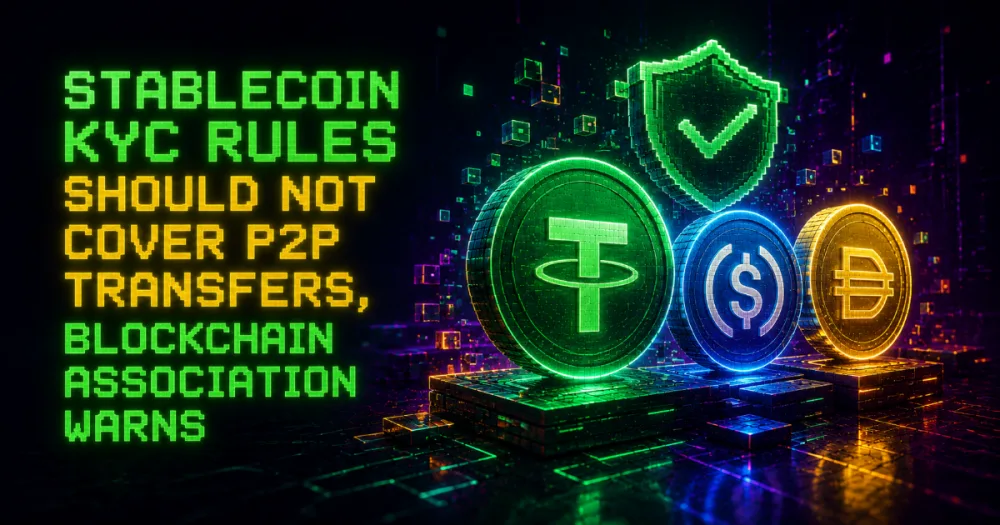

The Blockchain Association has urged U.S. regulators to establish a bright line on customer identification requirements for stablecoins that would cover only issuer and customer relationships and not peer-to-peer transfers between customers.
The group submitted comments prior to the Aug. 21 deadline for a joint proposal from FinCEN, the Office of the Comptroller of the Currency, Federal Reserve, the FDIC, and the NCUA, suggesting clearer definitions and flexibility for digital identity technology.
Permitted payment stablecoin issuers would be subject to a written, risk-based customer identification program as a part of AML controls, and generally required to collect a customer’s name, address, date of birth or formation, and identification number before opening a customer’s account, and to verify this information using documentary or non-documentary methods.
1/ On Friday, Blockchain Association filed comments on federal agencies’ proposed customer identification requirements for permitted payment stablecoin issuers under the GENIUS Act.
We support the goal of preventing illicit use of digital assets, and support the proposal’s core… pic.twitter.com/ED0CifzEqE
— Blockchain Association (@BlockchainAssn) August 24, 2026
The Blockchain Association argued that these requirements would only apply if the issuer has a direct relationship with a customer through issuance, redemption, conversion, repurchase or custody and that a user-to-user transfer should not be covered if the issuer did not intermediate, support or approve the transaction.
The agencies’ proposal largely follows this distinction, although merely holding an issuer’s stablecoin would not itself create an account. Thus, transfers of an issuer’s stablecoin through the issuer’s smart contract would generally be consistent with secondary market activity.
This includes transfers from one self-hosted wallet to another, purchasess. According to regulators, it is estimated that 99% of stablecoin transaction activity occurs in secondary markets where issuers are unable to identify token holders
Verification methods are another matter. The association supports digital identities and interoperable verification tools. The proposal would already allow documentary and non-documentary means of verification, with regulators asking if the final rules should incorporate digital identities and verifiable credentials.
The group also favors avoiding duplication by not checking customers if any bank, exchange or other regulated institution has already done so.
End/ The GENIUS Act created a landmark framework for payment stablecoins.
Implementation should preserve its goals: strong safeguards, workable rules, and room for continued innovation.
Our full comment: https://t.co/qqXe4o5T4o
— Blockchain Association (@BlockchainAssn) August 24, 2026
An issuer could rely on certain work of another federally regulated financial institution, only if this reliance was reasonable, documented in a contract and subject to annual certification by the other institution.
The regulators will next review the comments and publish final definitions of the terms “account”, “customer” and “digital asset service provider” and provide a 12-month transition period for issuers to comply with the final rule.
The identification framework would be in addition to other provisions of the GENIUS Act such as licensing, reserves, anti-money laundering, compliance with sanctions, compliance with lawful orders, and the treatment of peer-to-peer transfers, digital credentials, and third-party verification.
